Remember the days when rendering a single frame of 3D animation meant waiting hours—sometimes days—while your computer sounded like a jet taking off? For generations of animators, the render farm was both a necessity and a nightmare. You planned your shots, built your scenes, and then surrendered to the waiting game.
That era is ending. In 2026, artificial intelligence has fundamentally rewritten the rules of 3D production. The render farm isn’t disappearing, but its role is transforming from brute-force number cruncher to intelligent creative partner.
The render time revolution
The numbers are staggering. Modern AI-powered workflows can cut render times by 50% to 80% compared to traditional methods . This isn’t magic—it’s intelligent optimization.
AI denoising has been the biggest game-changer. Traditional path-traced rendering required thousands of samples per pixel to eliminate noise, each sample demanding computational power. AI denoisers like NVIDIA OptiX use deep learning to predict and reconstruct missing lighting data. The result? Artists can render at 128–256 samples instead of 2,048 and maintain nearly identical visual quality .
AI upscaling adds another layer of efficiency. Instead of rendering directly in 4K—which consumes massive GPU resources—artists render at lower resolutions and let AI reconstruct high-frequency detail. Tools like NVIDIA DLSS can reduce GPU load by up to 90% while preserving sharp edges and lighting fidelity .
The all-in-one solution for modern creators
For 3D artists and animators navigating this new landscape, having access to multiple AI tools under one roof has become essential. Different models excel at different tasks—some specialize in realistic motion, others in stylized animation, still others in consistent character generation.
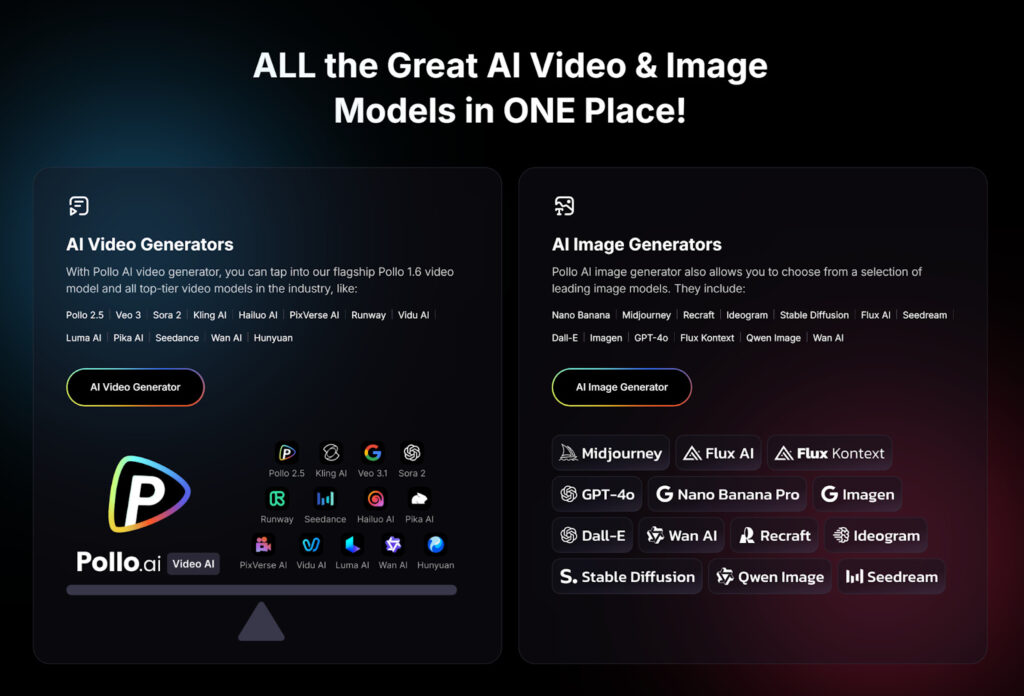
Pollo AI’s AI animation creator becomes a powerful addition to any 3D workflow. Available on both web and mobile apps, Pollo AI aggregates access to leading models including Pollo 2.5, Veo 3.1, Sora 2, Kling AI, Luma AI, and PixVerse—all within a single interface . For animators, this means testing concepts across different visual styles without switching between expensive tools or managing multiple subscriptions.
The platform’s capabilities extend beyond simple video generation. Text-to-video and image-to-video tools transform concepts into moving visuals instantly. For 3D artists working on pre-visualization, this means client concepts that once required rough 3D blocking can now be generated in minutes. The “reference to video” feature helps maintain character consistency across scenes —crucial when you’re iterating on design variations.
Perhaps most valuable for busy animators is the Pollo AI mobile app, which puts professional-grade tools in your pocket. While your main machine churns through heavy 3D renders, you can be generating concept variations, testing animation ideas, or creating social content on your phone. The app includes over 150 viral effects and templates —perfect for studios needing to create promotional content without pulling artists off production work.
The hybrid workflow
The smartest studios aren’t choosing between traditional rendering and AI—they’re combining both. Here’s what that looks like in practice:
Pre-visualization and concept development happens with AI tools like Pollo AI, generating dozens of style options in minutes rather than days . Clients approve direction before expensive production renders begin.
Core rendering still happens in traditional 3D software, but with AI acceleration. Neural denoisers clean up frames during render time. AI upscalers let artists work at manageable resolutions while delivering 4K finals.
Post-production and variations leverage AI for efficiency. Need a different camera angle? Generate it with AI rather than re-rendering. Want to test a color scheme? AI tools handle it instantly.
The economics of faster workflows
The business case is compelling. Traditional rendering costs scale linearly with complexity. AI-assisted rendering changes the equation entirely. By combining AI-powered tools with professional render farms, artists can achieve faster turnaround times, higher-quality results, and greater workflow flexibility than ever before .
For independent creators and small studios, this democratization is transformative. Tasks that once required enterprise-scale render farms are now accessible to anyone with a laptop and an internet connection.
What’s next
The rendering world is entering its intelligent phase. By 2026, neural rendering will underpin most production pipelines, hybrid workflows will be standard infrastructure, and AI-orchestrated efficiency will determine profitability .
The question is no longer whether AI will transform your 3D workflow. It’s how quickly you’ll adapt—and whether you’re using tools like Pollo AI to stay ahead of the curve while your renders finish in hours instead of days.