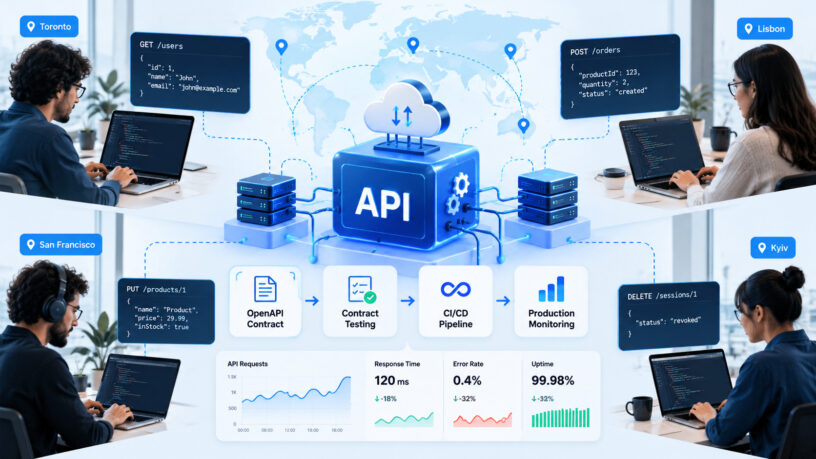
APIs rarely break because someone wrote bad code. They break because an engineer in Lisbon renamed a response field on Tuesday while a colleague in Toronto built a client against Monday’s schema.
API-first is no longer the ambitious choice – it’s the boring default. Scaling that default across time zones creates friction that no linter can catch. When companies hire remote developers to stretch API capacity, technical chops turn out to be the easy checkbox. The expensive surprise: without shared conventions, explicit ownership, and quality automation that runs at 3 AM with zero human supervision, you’re paying for velocity you’ll never actually receive.
Define API contracts before writing code
Engineers without a shared API spec will each invent a perfectly reasonable version of the truth. Those versions will meet in production and start a fistfight.
OpenAPI solves this with paperwork before code: agreed request structures, response shapes, error formats – all frozen before implementation begins. Frontend and backend stop playing telephone and start working from the same blueprint at the same time.
| Practice | Purpose |
| OpenAPI specification | Single source of truth for endpoints, types, and responses |
| Service ownership | One person responsible for architecture, compatibility, and incidents per API |
| Versioning strategy | Prevents breaking changes from reaching consumers unannounced |
McKinsey’s research on developer velocity pins performance on four things: tooling, talent management, culture, and product management. Remove the hallway conversation as a fallback – which remote work does by default – and these four either carry the team or bury it.
Let machines review what humans can’t stay awake for
Pull requests don’t respect time zones. A PR opened in Kyiv at 6 PM waits until San Francisco wakes up: eight dead hours where momentum goes to rot. Automation eliminates the coma between push and feedback.
Practices you either enforce or regret not enforcing:
- Contract testing. Verify that API changes remain compatible with existing consumers before merging.
- CI/CD pipelines. Run automated tests, linting, and security scans on every push. No exceptions, no manual gates.
- Centralized documentation. Keep API specs, implementation decisions, and integration guides in one searchable location.
- Production monitoring. Track error rates, response times, and failed requests. Surface anomalies before users file tickets.
- Peer review with async-friendly rules. Set maximum review turnaround times. Require approval for breaking changes; auto-merge low-risk updates.
Online developer tools – REST clients, schema validators, mock APIs – become force multipliers here. A developer hitting a mock server at midnight gets answers without setting off anyone’s phone.
Your Infrastructure has a headcount too
Hiring three engineers doesn’t triple your API capacity. It triples the traffic nobody budgeted for. Capacity planning belongs on the same timeline as the job req, not in the postmortem doc. Stress-test volumes, database behavior under real concurrency, rate limits, and auth costs before launch day, not during it. Load testing reveals the physics hiding behind clean pull requests.
The 2025 DORA report skips diplomacy: maturity determines outcomes. Without solid testing and monitoring, shipping faster just means crashing faster with better commit messages.
Track what actually matters
Deployment frequency means nothing if change failure rates climb alongside it. Measure quality and speed together:
- Lead time: commit to production, in hours
- Change failure rate: percentage of deployments causing incidents
- Recovery time: minutes from detection to resolution
- Contract compliance: percentage of endpoints matching their published spec
One rule: if deployments go up and rollbacks go up at the same pace, you don’t accelerate – you just break things faster and with more confidence.
Distributed API teams that actually work share three boring traits: contracts nobody can misread, quality gates nobody can skip, and infrastructure that grew before the team did.