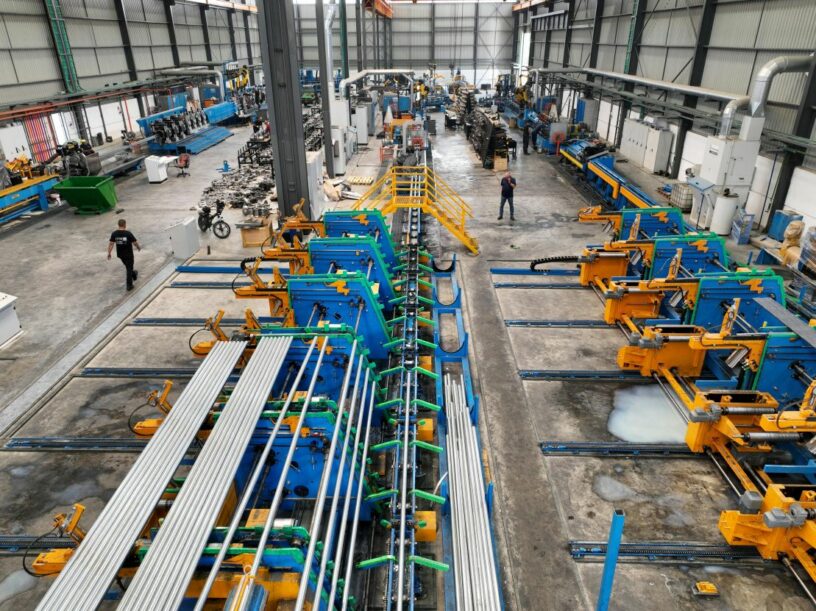
The factory of today looks nothing like the one your grandfather clocked into. Machines talk to each other. Sensors stream data every millisecond. Software makes decisions that once required a room full of engineers. While most are digital, someone has to keep everything connected, secure, and running smoothly.
The person or team responsible for technology in modern manufacturing must create a seamless connection between the assembly lines and the servers running in a data center thousands of miles away.
This article breaks down what it takes to manage information technology (IT) complexity in a world where the factory floor and the cloud are inseparable.
Complexity is a real problem
A modern plant can’t run without production technology on the floor. You’ll see industrial sensors, IIoT devices (Industrial Internet of Things) feeding into control systems, machines equipped with real-time machine data streams. Above that, you have enterprise software: an enterprise resource planning platform managing finance and procurement, a manufacturing execution system tracking every step of production.
Layer in cloud infrastructure, cybersecurity tools, remote monitoring dashboards, and third-party integrations, and you’re managing a deeply interconnected ecosystem where a single failure can cascade fast.
The IT/OT Gap
The issue lies in the gap between operational technology (OT) and IT. OT systems were designed for reliability and uptime, and not connectivity. IT systems were designed for flexibility and scalability, and not factory floors. When you try to connect them, you hit friction at every seam: incompatible protocols, different security requirements, and teams that speak completely different languages.
Data silos
Manufacturers also struggle with data fragmentation. Production data collection happens across dozens of systems, but that data often sits in silos. Your quality management system doesn’t talk to your inventory management platform. Your advanced planning and scheduling system pulls numbers that are already outdated by the time someone acts on them. The result? Decisions made on incomplete pictures.
This is where IT support for manufacturing becomes a critical function. Specialized IT support comprises partners that understand both the technology stack and the operational realities of a plant. They bridge the OT/IT divide by integrating disparate systems, establishing data pipelines that work, and building a resilient architecture that keeps production running amid disruptions. Without that expertise, manufacturers often find themselves reacting to crises instead of preventing them.
Manufacturers increasingly depend on reliable networking infrastructure to connect production systems, cloud platforms, remote monitoring tools, and business applications across multiple locations. For many small and midsize businesses, managing these systems can become complex without the right support. This is why insights from industry professionals such as Rhino Networks CEO Todd Carriker on Cisco managed services and SMB network infrastructure are relevant when discussing modernization, integration, security, and long-term operational resilience.
Modernizing production work
One of the clearest wins from digital transformation is process automation. Change orders that once required days of manual routing, approvals, and documentation can be triggered, tracked, and closed in hours.
3D printing is reshaping prototyping and short-run production. Artificial intelligence is moving from pilot projects into core production workflows. AI-driven robots are taking on tasks that were too variable or complex for traditional automation.
Automating engineering workflows is key to efficient operations, as the manufacturing sector can’t move on without these tasks. Simulation software lets engineers test a design change virtually before a single physical component is touched, slashing prototype costs and compressing development cycles. Digital twins or virtual replicas of physical assets and entire production environments let you model scenarios, predict failures, and optimize configurations without stopping the line.
A car manufacturer deploying automotive IoT across its production lines, for instance, can reduce quality escapes by correlating real-time sensor data with defect patterns. This would have taken weeks of manual analysis before. The same data, processed through data analytics platforms, also feeds into smarter scheduling and capacity planning.
Simplifying other operational processes
The benefits extend well beyond engineering. Here’s where digital transformation tends to deliver the most measurable impact in manufacturing operations:
- Predictive maintenance and asset reliability: Using machine learning and real-time data from connected equipment, manufacturers can predict failures before they happen. Doing so reduces unplanned downtime that can cost tens of thousands of dollars per hour in some facilities.
- Supply chain visibility and responsiveness: With big data and business intelligence tools pulling from across the supply chain, teams can spot disruptions earlier, adjust inventory levels proactively, and avoid the bullwhip effect that sends shockwaves through supply chain management when demand signals get distorted.
The key is that automation compounds. Each workflow you streamline frees up capacity to tackle the next one. Each dataset you integrate gives your data analysis tools more to work with. Over time, you build a manufacturing IT environment where the system itself surfaces insights rather than waiting for someone to go looking for them.
Keeping the lights on securely
Smart factories are powerful, but they’re also exposed. The current industrial revolution wired factories to everything. Every IIoT device you add to the network is a potential entry point. Every cloud integration is a surface that needs defending. Augmented reality tools are also changing how manufacturers handle maintenance and training, allowing technicians to overlay digital instructions onto physical equipment in real time. But these tools need secure, low-latency connectivity to work.
Manufacturers have become prime targets for ransomware and industrial espionage, partly because their security posture has historically lagged behind their technology ambitions.
That said, teams must develop a different approach to security. Zero-trust architecture, network segmentation between IT and OT environments, and rigorous patch management are a must. So is disaster recovery planning. If your manufacturing technology goes down and you don’t have a tested recovery plan, you’re not just losing production but customer contracts as well.
The push toward smarter operations
Manufacturing has never stood still, but the pace of change right now is genuinely unprecedented. A 2025 survey revealed that 80% of America’s top manufacturing companies planned to spend at least 20% of their improvement budgets for smart manufacturing processes. These initiatives include automation hardware, IoT sensors, and data analytics, among others.
The manufacturing industry is treating technology as a competitive differentiator, not merely a support function. Companies that get their IT infrastructure right will run leaner, respond faster, and outmaneuver rivals still stitching together legacy systems with spreadsheets and gut instinct.
This shift makes digital transformation a baseline expectation. Moreover, the digital manufacturing process is evolving faster than most organizations can fully absorb. Hence, the infrastructure decisions you make today determine whether advanced manufacturing capabilities like these actually perform in practice.
The road ahead is worth taking
Managing IT complexity in manufacturing isn’t a problem you solve once. It’s an ongoing discipline. The companies doing it well treat information technology as a strategic asset, invest in the right expertise, and build architectures designed for change rather than stability alone.
You don’t have to implement everything at once. Instead of chasing every technology, build a solid foundation, integrate systems thoughtfully, and create the data infrastructure that lets you act on what you learn. Start there, and the complexity becomes manageable. Ignore it, and it becomes the ceiling on everything you’re trying to build.










Leave a Reply