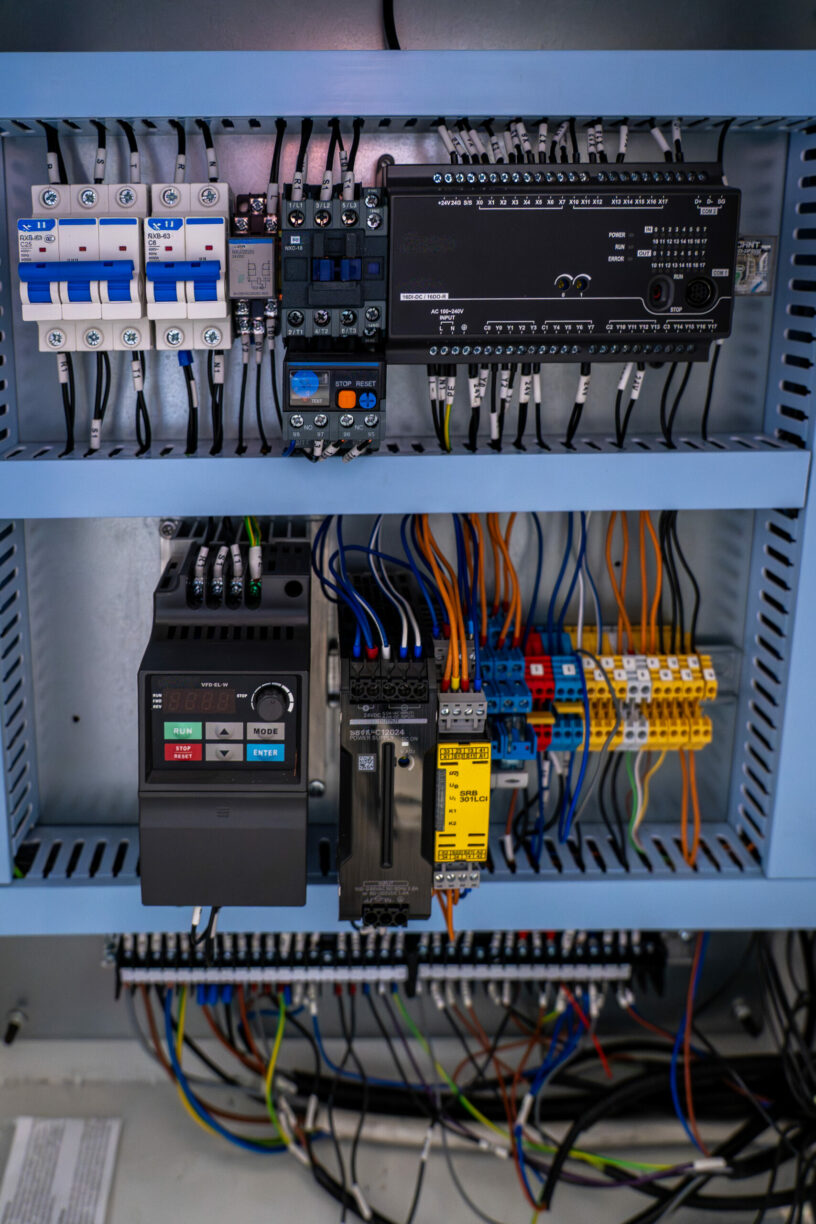
PLC programs directly influence machine sequences, process parameters, diagnostics and recovery after faults. They should therefore be engineered as maintainable production software rather than treated as an opaque collection of rungs that is edited during commissioning and forgotten until the next breakdown. A disciplined workflow combines modular design, repeatable testing, version control and controlled deployment while keeping machine risk, functional safety and operational responsibility in view.
Start with explicit boundaries and responsibilities
Before selecting Ladder Diagram, Structured Text or Function Block Diagram, define what the controller is responsible for. Record the machine states, operating modes, sequence transitions, I/O boundaries, external interfaces and expected response to communication loss or power restoration. Engineers who need a common technical baseline can begin with a practical introduction to PLC programming covering controller components, languages and industrial applications. The language choice should follow the problem: graphical logic may suit straightforward interlocks, while Structured Text can make calculations and reusable algorithms clearer.
The architecture must also distinguish standard control from safety-related functions. A standard PLC sequence must not silently become the only measure relied upon for risk reduction. Risk assessment according to ISO 12100 should identify hazardous situations and required protective measures; where safety-related parts of control systems are used, their design and validation may need consideration under ISO 13849-1 or another applicable framework. Software structure supports this work, but it does not by itself establish conformity or replace the manufacturer’s responsibility.
Build modules around machine behaviour
Useful modules reflect stable responsibilities rather than convenient screen layouts. Typical boundaries include mode management, actuator control, sequence execution, alarms, communication and recipe handling. Each module should expose a small, documented interface and define its permitted states. An actuator block, for example, can centralise command arbitration, feedback supervision, timeout handling and diagnostic status instead of duplicating those decisions throughout the program.
State machines are particularly effective for sequential equipment because they make transitions and abnormal paths visible. Every transition should have an explicit condition, and every state should define what outputs are permitted. Recovery deserves the same attention as normal production: engineers should specify what happens after an emergency stop, guard opening, communication interruption or controller restart. For larger integrations, dedicated industrial software architecture may be justified where standard MES or ERP functions cannot faithfully represent machine events, approvals and process exceptions.
Make tests deterministic and reviewable
A PLC test is useful only when its initial conditions, inputs and expected outputs can be reproduced. Create test cases for normal cycles, boundary conditions, invalid combinations, sensor disagreement, timeout expiry and interrupted sequences. Time-dependent logic should use controlled test inputs rather than requiring an engineer to wait through real production delays. Simulation can provide rapid feedback, but hardware-in-the-loop checks and tests on the actual machine remain important where electrical behaviour, drive responses or physical timing affect the result.
Separate functional tests from validation of safety-related functions. A sequence test may demonstrate that a conveyor stops when an interlock signal changes, but it does not by itself validate the complete safety function, its architecture or achieved performance. Test records should identify the software version, hardware and configuration used, prerequisites, expected result, actual result and reviewer. This creates evidence that can be repeated after a retrofit instead of relying on the memory of the commissioning team.
Put source, configuration and evidence under version control
Version control is valuable even when a proprietary engineering environment stores projects in binary or archive formats. Keep exported source where practical, but also retain the complete restorable project, hardware configuration, device parameters, HMI dependencies and instructions for rebuilding the release. Commit messages should explain the engineering reason for a change, not merely state that code was updated. Tags or release identifiers should connect the deployed controller program to its approved test record.
Access and integrity controls also matter because a technically correct repository offers little protection if uncontrolled copies can be downloaded to a machine. Define who may edit, review, approve and deploy each class of change. Service laptops, removable media, remote connections and shared engineering accounts should be included in the control model. An analysis of machine cybersecurity obligations can help teams examine product boundaries, interfaces, access paths and update responsibilities without assuming that secure individual components automatically create a secure overall system.
Deploy changes as engineering interventions
A PLC download can alter motion sequences, startup conditions, interlocks, timing and data exchanged with other systems. Classify the change before deployment and assess its possible effect on the process and risk-reduction measures. A robust plan defines prerequisites, the authorised version, a service window where necessary, backup and rollback arrangements, acceptance checks and the person empowered to return the machine to production. Guidance on production software update planning is especially relevant when several automation and IT components must remain compatible during a staged release.
Rollback must be technically meaningful. Restoring an old controller project may be unsafe or ineffective if drive parameters, HMI recipes, database schemas or device firmware have already changed. The team should identify which configuration set forms one release and verify that recovery will not create an inconsistent machine state. After deployment, confirm more than the absence of faults: test critical sequences, diagnostics, mode changes, restart behaviour and affected interfaces under controlled conditions.
Treat legacy code and conformity decisions with care
Legacy machines often contain the most operationally important code and the least reliable history. Before refactoring, establish the actual installed configuration, obtain a verified backup and compare documentation with machine behaviour. An assessment of undocumented used machinery illustrates why missing schematics, unknown modifications and uncertain control logic can turn an apparently simple intervention into a reconstruction project. Preserve behaviour deliberately, document deviations and avoid combining code cleanup with functional change unless both can be reviewed and tested independently.
Finally, decide early whether a modification affects safety functions, intended use, machine boundaries or interaction within an assembly. Those questions can change the required risk assessment, documentation and acceptance scope. An early conformity-assessment route review helps prevent teams from treating CE-related decisions as paperwork performed after the software is complete. No repository, test framework or external review provides automatic legal certainty; the defensible outcome comes from connecting design assumptions, risk reduction, verified implementation, change records and clearly assigned responsibility throughout the machine lifecycle.