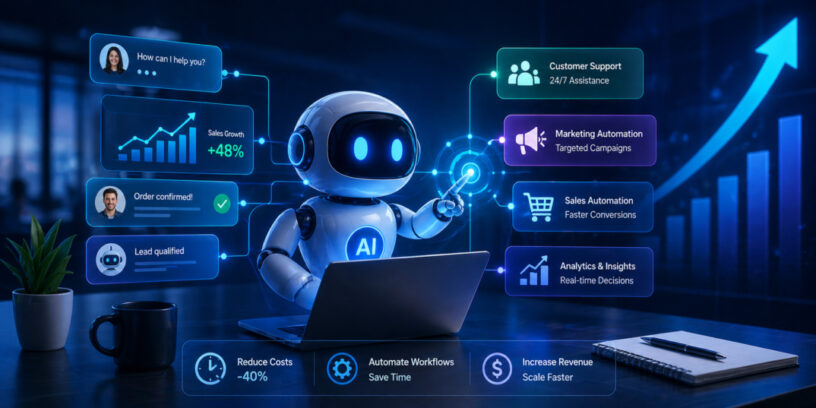
Stop letting manual workflows hold your business back. AI agents for business automations represent the most effective way to optimize your operations and accelerate both sales and customer communication processes.
You can rest assured that your clients are always receiving top-quality assistance while your business generates revenue around the clock.
We’re no longer talking about outdated automation tools that simply fire off pre-written messages with no flexibility. What we’re introducing today is a truly intelligent solution: an AI agent that understands context, makes decisions, and drives results. Slow response times, low productivity, and soaring costs are a thing of the past. It’s time to embrace a smarter approach!
What are AI agents for business automations?
You may have worked with a basic assistant before — one that offered simple, scripted replies and little else. AI agents operate on an entirely different level.
These are sophisticated systems capable of planning, managing, and executing goal-driven workflows. They don’t just respond to inputs; they understand business objectives and take meaningful action to achieve them.
Definition and core capabilities
An AI agent is an advanced software system that can perceive its environment — meaning it genuinely understands what customers need. Its core strength lies in its ability to interact fluidly with customers and pursue business goals through autonomous or semi-autonomous actions.
How AI agents for business automations differ from rule-based automation
The gap between traditional data-driven automation and AI agents is significant. While the former simply repeats the same predefined messages, the latter engages in coherent, natural conversations with customers. In short: one reacts to messages, the other actively helps the company grow.
Key technologies behind AI agents
One of the first questions new users ask is: how do AI agents automate business processes? The answer lies in the core technologies powering these systems:
- Reasoning Engines: Think of these as the “brain” of the system — they process information logically and arrive at sound conclusions. Chain-of-Thought (CoT), Small Language Models (SLMs), and autonomous planning are the key methods enabling this capability.
- Memory and Context: AI agents retain information from past interactions, allowing them to hold meaningful, continuous conversations with customers. Retrieval-Augmented Generation (RAG), Vector Databases, and long-term memory form the backbone of this capability.
- Governance and Security: AI agents don’t operate in isolation — like any reliable team member, they require oversight. Security frameworks and Identity and Access Management (IAM) are the primary tools that ensure responsible operation.
Research conducted by Gartner predicts that by 2028, 90% of B2B transactions will be facilitated by AI agents, moving over $15 trillion in global commerce. This will cement AI agents as the primary tool for millions of online businesses worldwide.
How AI agents key benefits drive business growth
Thanks to their intelligent operating structure and ability to handle complex situations autonomously, AI agents deliver a wide range of tangible advantages. This is precisely why companies continue to trust and invest in them time and again.
Elevate your customer experience
When customers receive personalized, dynamic, and real-time support, their entire perception of your brand shifts. The result is a satisfied customer who resolved their issue quickly, left with a positive impression, and developed genuine loyalty toward your business.
Accelerated revenue and sales velocity
The cost savings generated by AI agents are substantial — and revenue growth follows closely behind. By enabling automated, personalized management of sales processes, these tools help businesses accelerate their growth trajectory significantly.
Optimize performance with autonomous actions
The greatest advantage is the reduction in manual workload. Traditional automation tools always require someone working behind the scenes; with AI agents, that dependency disappears. The system optimizes business performance on its own through autonomous actions available 24/7.
Why companies are increasing investment in AI agents
In 2026, more and more companies are choosing to invest heavily in AI agents — and for good reason. This technology doesn’t just analyze market trends; it actively drives business outcomes.
Demand for scalability and efficiency
Rapidly growing demand has put enormous operational pressure on businesses. AI agents have emerged as the most effective solution to this challenge, reducing repetitive tasks and enabling processes to run more smoothly and efficiently.
Reducing operational costs
By 2025, companies were already achieving a 37% reduction in marketing costs through AI agents. In 2026, that figure is expected to exceed 40%. These numbers position AI agents among the most compelling automation solutions available to small and medium-sized businesses.
Improving decision-making with real-time data
To make better decisions, businesses need to offer customers products and services that align with their preferences. AI agents support this by capturing critical data in real time to inform and improve business processes. According to 2025 data, 74% of organizations using intelligent agents reported a positive ROI, while 71% identified direct increases in their annual revenue as a result of this technology.
Integrating AI agents into existing systems
Working as part of a team always delivers stronger results than going it alone — it distributes the operational load and creates a dynamic, efficient workflow that propels every process forward. AI agents are built with this principle in mind, designed to integrate seamlessly with existing systems.
CRM and marketing platform integration
CRM software is built to create personalized customer interactions. When integrated with AI agents, its capabilities expand dramatically. The software identifies critical data while the agents process it strategically to drive real business outcomes.
Modern CRM platforms have become the ultimate ally for AI automation in small businesses. Kommo’s AI stands out as one of the most effective solutions for experiencing the full benefits of this integration firsthand, combining conversational intelligence with powerful CRM functionality.
Building scalable automation ecosystems
The ability of AI agents to create scalable automation ecosystems stems from their capacity to bring together software tools, artificial intelligence, and business processes to maximize efficiency. HubSpot, for example, offers AI-powered sales tools designed to enhance content management and build compelling campaigns with its blog post generator.
Challenges and considerations
According to Harvard Business Review, AI agents don’t entirely eliminate manual labor — in fact, they can intensify it in certain contexts. A study conducted with 200 employees concluded that the increased workload is a very real phenomenon.
This only reinforces the fact that we’re not dealing with a perfect tool, but one that comes with its own set of challenges that must be thoughtfully addressed. The question isn’t just how AI agents automate business processes — it’s how to use them in the smartest way possible.
Data quality and system integration
For any system to function effectively, a balance must be struck between data sources and data quality. When systems fail to communicate, information becomes fragmented; when data quality is poor, actions fail. It’s essential to verify that your chosen platform meets the standards of accuracy, integrity, and consistency — and that it supports long-term data storage.
Avoiding over-automation
One of the biggest risks is becoming overly reliant on AI agents and letting them handle everything independently. This approach leads to depersonalization and erodes customer trust. The key is balance: let AI handle routine, repetitive tasks while human agents focus on interactions that require empathy, creativity, and nuanced judgment.
My own point of view
As a researcher, writer, and team member at one of the world’s leading CRM companies, I can say with confidence that AI agents are the most impactful tool I’ve encountered in this space.
This isn’t just my personal opinion — it’s backed by the countless companies that have adopted this technology and continue to rely on it. Global giants like Amazon, Tesla, and Netflix run significant portions of their customer service operations through AI agents.
Yes, implementation can be challenging — but it’s absolutely worth it. By the end of 2025, 10% of those actively using this technology reported significant improvements in their productivity. In my view, the opportunity to become part of that 10% and meaningfully improve your results within a year is one worth seizing.
Final thoughts: Why you need this integration
After reviewing everything we’ve covered, one question rises to the top: why do you need AI agents for business automations?
There are many reasons, but the most fundamental one is this: it’s the most powerful solution available for overcoming your business challenges and achieving smoother, more efficient operations. The time has come to integrate solutions like Kommo AI and take full advantage of the best automation tools available in 2026.
To summarize
Three key takeaways stand out:
- AI agents are advanced systems that help you identify areas for improvement and achieve optimal results across your business operations.
- The benefits of this technology allow you to enhance customer experience, streamline operations, and boost overall performance.
- Integrating complementary marketing tools accelerates your path to success — CRM systems rank among the most powerful options available.
Furthermore, real-world research and case studies from companies already leveraging the combined power of AI agents and CRM continue to demonstrate exponential, sustainable growth.
The time for action is now — integrate AI agents into your business automations today!