Voiceflow is good for prototyping. You can build a working voice agent demo in a day, show it to stakeholders, and move fast without involving engineering. That’s real value.
But when teams move from prototype to production, they hit the same set of walls. Voiceflow routes calls through third-party carriers it doesn’t control. It’s per-editor pricing scales against you. There’s no self-hosted option for regulated industries. And Voiceflow’s own documentation puts enterprise production timelines at 90 days: a long way from the “build in minutes” pitch.
This article covers the best Voiceflow alternatives for 2026. The platforms below take different approaches to production voice AI. Some focus on no-code development, others on open-source flexibility, while some provide their own telecom infrastructure.
Best 7 Voiceflow alternatives: Quick overview
| Provider | Deployment Model | Compliance | Pricing |
| Telnyx | Fully-owned infrastructure (telephony, STT/TTS, GPU inference) | SOC 2 Type II, HIPAA, PCI DSS, ISO 27001, GDPR | $0.05/min base (STT + TTS included) |
| Botpress | Self-hosted, open-source | SOC 2 Type II | From $150/month |
| Vapi | Developer-first API, BYO providers | SOC 2 Type II, HIPAA, GDPR (PCI depends on sub-vendors) | From $0.05/min |
| Bland AI | Self-hosted GPU or managed cloud | SOC 2 Type II, HIPAA, GDPR, PCI DSS (ISO 27001 not listed) | Usage-based, per connected minute |
| Rasa | Fully self-hosted, code-first | SOC 2 Type II (Enterprise edition) | Custom |
| Sierra | Vendor-operated (“agent as a service”) | Not listed publicly | Custom pricing |
| Kore | Vendor-managed enterprise suite | Available on request | Custom |
1. Telnyx
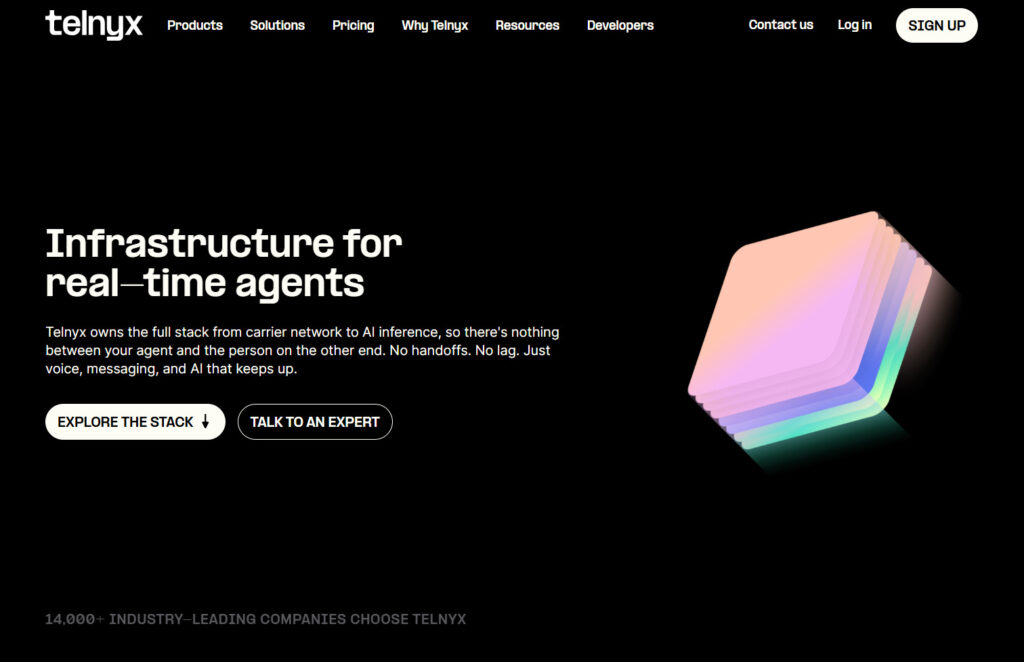
Telnyx is the strongest Voiceflow alternative for teams moving to production. The core difference from every other option on this list: Telnyx owns its carrier network, its GPU inference clusters, its speech-to-text, and its text-to-speech. Nothing routes through a third party. The entire call, from the moment it connects to the moment the AI responds, stays on one private backbone.
That matters in production because latency problems in voice AI almost always come from the gaps between vendors, not from any single vendor. Telnyx closes all those gaps by being the only vendor.
Standout features
- Inbound and outbound phone calls over the PSTN with no third-party carrier
- Real-time STT and TTS running on the same network as the call
- Open-source LLM inference on Telnyx-owned GPUs, co-located with the call path
- Full call control: DTMF, warm transfers, live recording, SIP interoperability
- Voice, SMS, WhatsApp Business, and email natively on the same owned infrastructure
- Phone numbers in 100+ countries with local calling in 80+ markets
- No-code AI Assistant Builder for teams that want to build without writing API calls
Performance & compliance
- Performance stays strong across the board: real-time voice responses come back in under 200ms round-trip, uptime holds at carrier grade thanks to a Tier-1 private network spanning 17 global points of presence, and the platform scales to millions of concurrent calls without any drop-off in performance.
- Compliance is just as solid. The platform carries SOC 2 Type II, HIPAA, PCI DSS, ISO 27001, and GDPR certifications, with EU-deployed infrastructure to keep data in-region where required. Because one vendor covers the entire call path, there are no sub-processor compliance gaps to track down or manage.
Pricing: A pay-as-you-go pricing model, charging $0.05 for the conversational AI base rate (with STT and TTS included in the cost).
Best for: Engineering-led teams migrating from Voiceflow’s prototype environment to production voice AI with carrier-grade infrastructure, full compliance, and predictable pricing.
2. Botpress
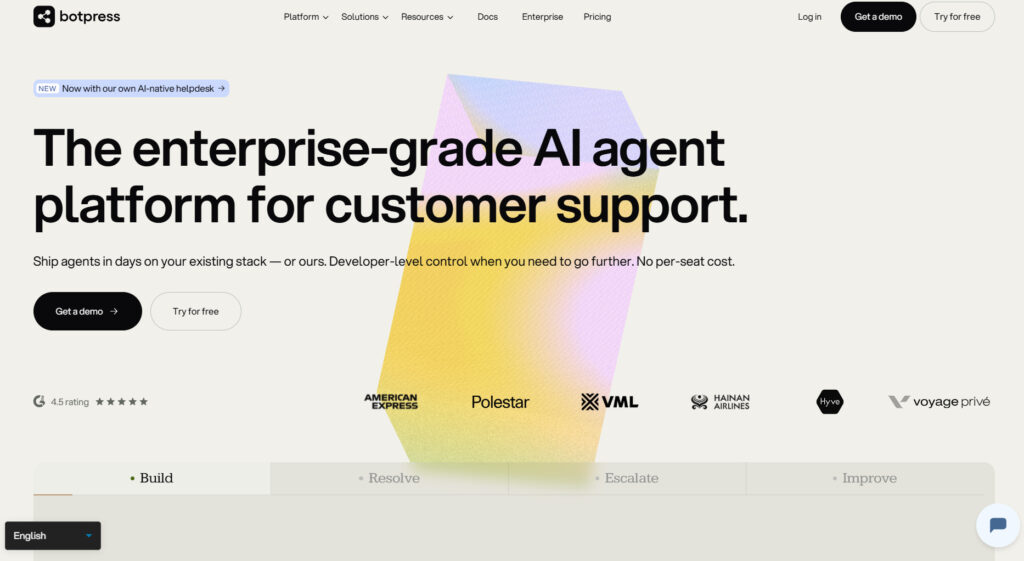
Botpress is an open-source, LLM-agnostic conversation builder with a self-hosted deployment path. It’s the closest alternative to Voiceflow’s visual canvas experience, but it adds the ability to run on your own infrastructure.
Key features
- Visual conversation flow builder with LLM integration
- Self-hosted deployment on your own infrastructure
- 190+ integrations with third-party tools
- Supports LLM providers (OpenAI, Anthropic, local models)
- Voice via third-party telephony integrations
Performance & compliance
- Performance depends on your hosting setup and chosen telephony provider
- No owned carrier infrastructure: latency is carrier-dependent
- Compliance: SOC 2 Type II
- Self-hosted deployment means you control your own data boundary
Pricing: A pay-as-you-go model available. Pricing plans start at $150/month.
Best for: Teams that want Voiceflow’s visual-builder experience with the added option of self-hosting for data sovereignty, especially in less-regulated verticals.
3. Vapi
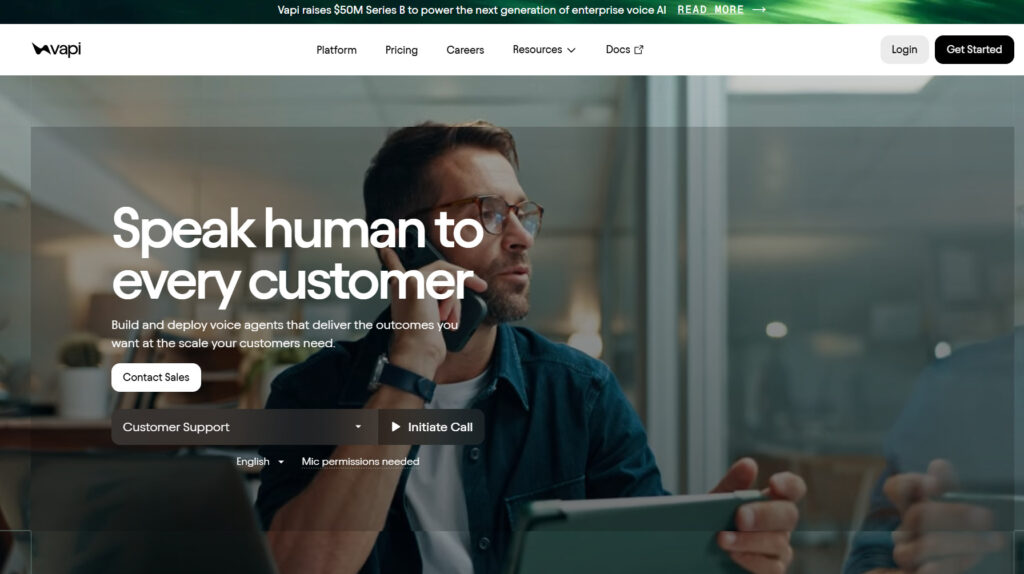
Vapi is a developer-first voice orchestration platform. It abstracts telephony, speech processing, and model routing into a single API, letting engineers pick their own LLM, STT provider, and TTS provider without building the plumbing from scratch.
Compared to Voiceflow, it trades the visual canvas for API flexibility and developer speed.
Key features
- Inbound and outbound calls via Twilio, Vonage, or your own SIP trunk
- Support for LLMs: GPT-4o, Claude, Gemini, Llama, and others
- STT and TTS with multiple provider options (Deepgram, ElevenLabs, etc.)
- Function calling and tool use during live calls
- Call monitoring dashboard and analytics
Performance & compliance
- Latency depends on which STT, LLM, and TTS providers you connect to
- No private network: calls are routed through third-party carriers
- Best for low-to-medium call volumes
- Compliance: SOC 2 Type II, HIPAA, GDPR
- PCI coverage depends on your chosen sub-vendors
Pricing: Pricing starts from $0.05/min. Full production stack with SIP, LLM, STT, and TTS adds up to $0.24-0.34/min depending on providers
Best for: Developers who need to ship a working voice AI agent quickly with maximum flexibility over which models and providers power it.
4. Bland AI
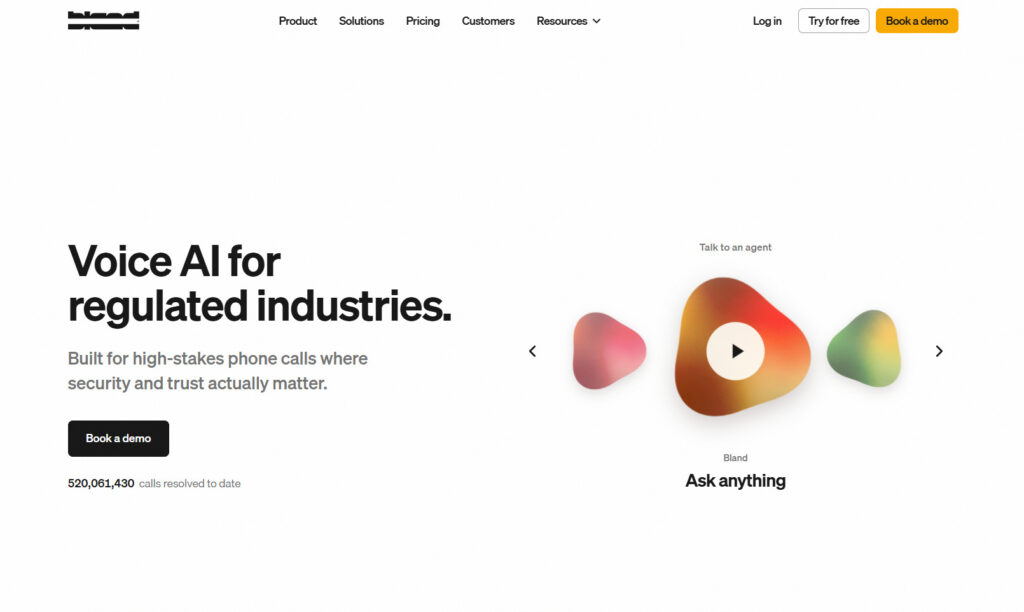
Bland AI is built for enterprises that want to run voice AI on their own hardware. Its self-hosted deployment runs on dedicated GPU clusters, which means call data never touches shared infrastructure.
Key features
- Inbound and outbound calls via third-party carriers
- Conversational Pathways: visual builder for complex multi-step call logic
- Self-hosted deployment on dedicated GPU clusters
- Batch calling for high-volume outbound campaigns
- Real-time transcripts and post-call analytics
Performance & compliance
- The self-hosted GPU option eliminates shared infrastructure latency
- Carrier latency still applies: Bland doesn’t own the network
- Managed cloud option available for teams that don’t need self-hosting
- Compliance: SOC 2 Type II, HIPAA, GDPR, PCI DSS. ISO 27001 is not publicly listed
Pricing: Usage-based pricing per connected minute
Best for: Regulated enterprises in insurance, finance, or logistics that need dedicated compute and can’t accept shared GPU infrastructure.
5. Rasa
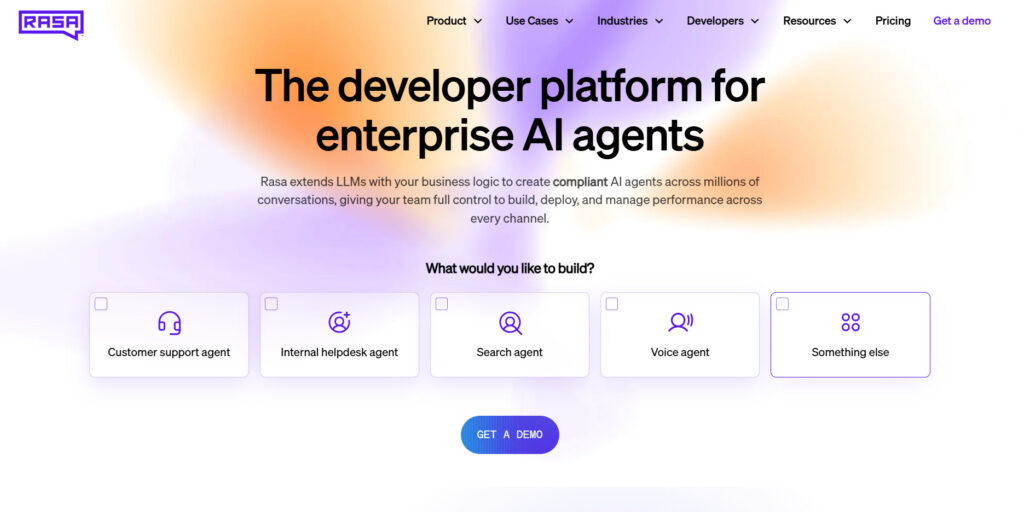
Unlike Voiceflow, Rasa is fully developer-driven: there’s no visual canvas. Everything is defined in code, which gives you complete control over conversation logic, model selection, and deployment.
Key features
- Open-source NLU and dialogue management framework
- Self-hosted deployment on your own infrastructure
- Supports custom ML models and third-party LLM integration
- Voice via third-party telephony integrations
- Enterprise edition with additional tooling and support
Performance & compliance
- Performance is entirely determined by your hosting setup
- No latency added by Rasa’s infrastructure: you control the full stack
- Requires engineering investment to optimize for production voice use cases
- Compliance: SOC 2 Type II for the enterprise edition
Pricing: Custom pricing
Best for: Enterprise engineering teams that need full control over conversation logic, model selection, and data sovereignty and have the technical capacity to build and maintain it.
6. Sierra
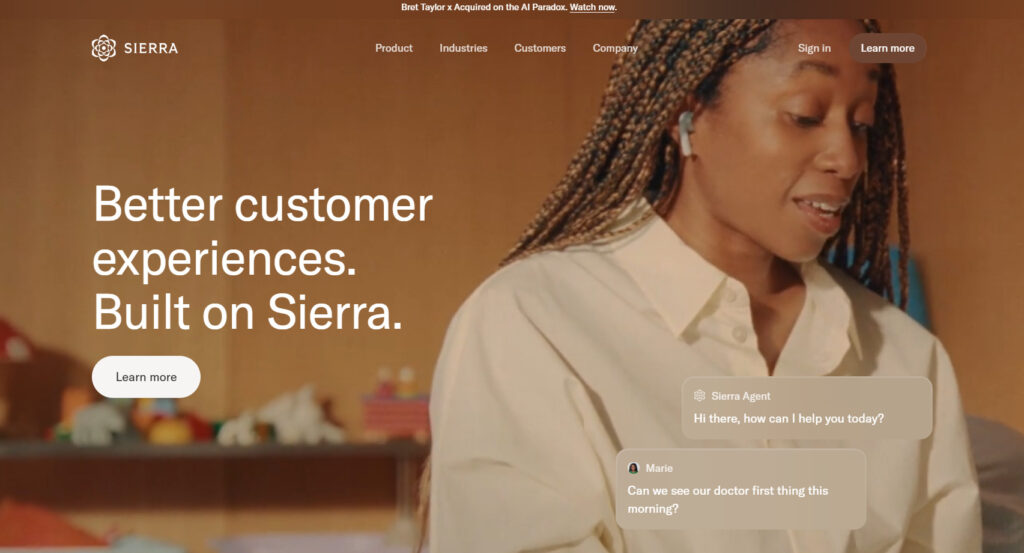
Sierra is a CX agent platform built around a multi-agent coordination model, where multiple specialized agents hand off context to each other rather than one bot handling everything. It’s positioned at enterprise CX teams, replacing legacy chat or IVR systems with branded AI agents.
Key features
- Brand-level CX agent personalization with long-lived memory across conversations
- Multi-agent constellation model: specialized agents coordinate and hand off context
- Production CX-grade agents for customer support, returns, troubleshooting, and more
- Voice and chat coverage
Compliance
- Enterprise-grade; specific certifications not publicly listed, requires a sales engagement
Pricing: Custom enterprise pricing, six-figure annual contract value
Best for: Brand-led enterprise CX teams replacing legacy IVR or chat agents with personalized AI at scale.
7. Kore.ai
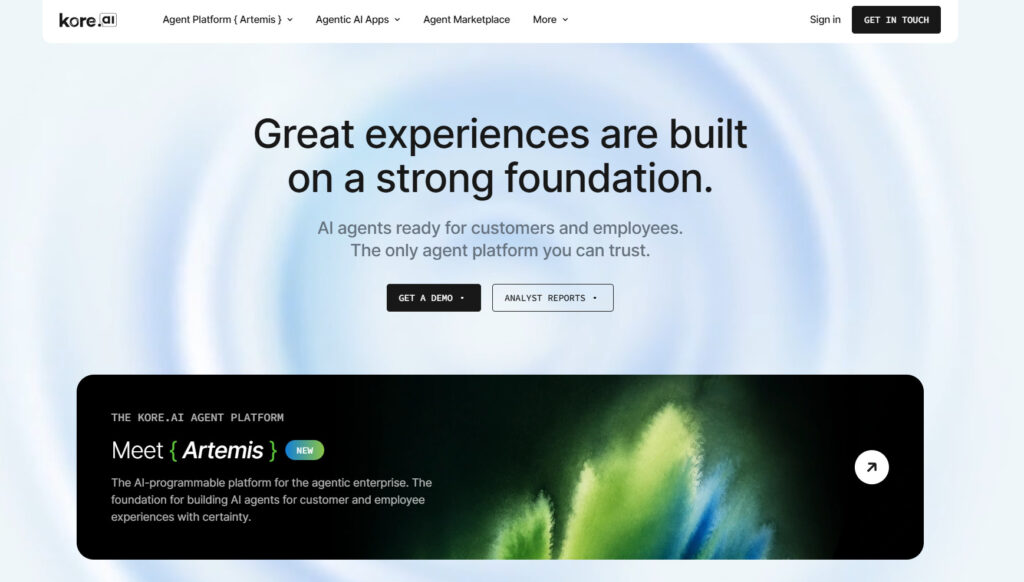
Kore.ai is an enterprise voice and chat platform with a wider product suite than most alternatives on this list. It covers self-service agents, live agent assist, and proactive outbound outreach from one platform, making it suited for enterprises that need all three in a single vendor relationship.
Key features
- Self-service AI agents for voice and chat
- Live agent assist: real-time guidance for human agents during calls
- Proactive outreach: automated outbound voice and messaging campaigns
- Contact center analytics and reporting
- Integrations with major CRMs and contact center platforms
Compliance
- Enterprise-grade; specific certifications available on request
Pricing: No public rates available. They offer custom enterprise pricing.
Best for: Enterprises that need self-service, agent assist, and proactive outreach all in one platform under one contract.
Final words
So, the right choice depends on where you are in your build and what you can’t compromise on.
Neither path is more “correct” than the other; they answer different questions. The right choice comes down to how much infrastructure your team wants to own, how much control you need over latency and compliance, and whether you’re ready to build in-house or ready to buy the outcome outright.









Leave a Reply