Quick Summary: Top 5 EHS Software Platforms for High-Risk Industries in Canada
- BIS Safety Software Canada: Best overall choice for Canadian high-risk industries that need AI-powered tools, compliance and training in one platform, and comprehensive safety management functionality.
- Cority: A strong enterprise EHS option for larger organizations that need safety, compliance, environmental, quality, sustainability, occupational health, and risk management capabilities.
- VelocityEHS: A broad EHS platform suited to organizations that need safety, chemical management, ergonomics, operational risk, compliance, training, and reporting tools.
- SafetyCulture: A flexible inspection and operations platform that helps field teams digitize checklists, inspections, issue tracking, corrective actions, and safety observations.
- Intelex: A configurable EHSQ platform well suited to larger organizations that need compliance management, incident tracking, audits, quality, environmental programs, and performance reporting.
High-risk industries in Canada face safety demands that are more complex than basic policy management or annual training. Construction, oil and gas, mining, transportation, manufacturing, utilities, forestry, logistics, and industrial services all depend on reliable safety systems to keep workers trained, documentation current, hazards controlled, incidents investigated, and compliance records ready when they are needed.
For safety managers, the challenge is not just knowing what needs to be done. The challenge is managing safety activity across multiple job sites, crews, contractors, supervisors, vehicles, equipment, shifts, and regulatory obligations. In many organizations, safety information is still spread across paper forms, spreadsheets, shared drives, inboxes, and disconnected software tools. That creates risk. It makes it harder to see training gaps, follow up on overdue inspections, monitor corrective actions, and prove compliance during audits or incident reviews.
EHS software helps solve that problem by centralizing safety management. The right platform gives safety managers better visibility into training, compliance, inspections, incidents, risk, audits, assets, contractor requirements, and field-level safety activity. It should reduce administrative work, support consistent documentation, and make it easier to understand what is happening across the organization.
For high-risk industries in Canada, EHS software should be practical enough for the field and powerful enough for leadership. Workers and supervisors need tools they can use quickly, while safety managers need reporting, records, and oversight. A platform that only works for the office will fail in the field. A platform that only collects forms will not be enough for serious compliance management.
Below are five EHS software platforms safety managers in high-risk Canadian industries may want to consider, ranked based on practical safety management needs, Canadian relevance, field usability, compliance support, training oversight, and overall value for safety teams.
1. BIS Safety Software Canada
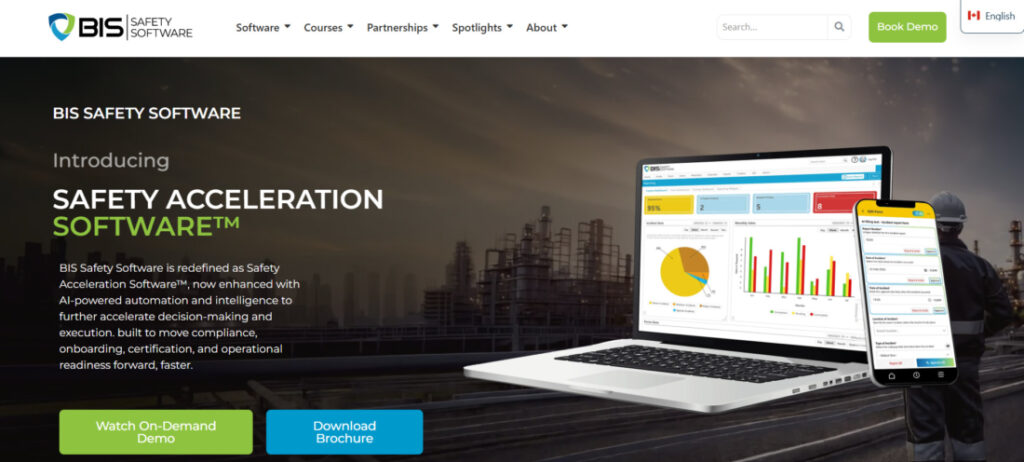
BIS Safety Software Canada ranks first because it directly addresses the combination of needs that safety managers in high-risk industries deal with every day: training, compliance, field execution, records, risk, incidents, inspections, and reporting. For Canadian companies working in construction, oil and gas, mining, transportation, manufacturing, and other high-risk sectors, those areas cannot be treated as separate responsibilities. They are connected parts of the same safety program.
The strongest value proposition for BIS is that it combines AI-powered safety software, compliance, and training in one platform. That combination matters because training is one of the most important controls in high-risk work. A worker may need site orientation, equipment training, WHMIS, ground disturbance training, confined space training, fall protection, driver training, supervisor training, competency validation, or task-specific certification before work can begin. If training records are managed separately from field safety activity, gaps are easier to miss.
BIS helps safety managers keep workforce readiness and safety documentation together. Its platform supports learning management, training records, training matrices, digital forms, orientations, inspections, hazard assessments, incident management, competency assessments, toolbox talks, equipment management, pre-trip inspections, lone worker tools, COR audit support, risk management, audits, and other EHS workflows. For safety managers, that creates a stronger foundation than using one tool for training, another for forms, another for incidents, and another for audits.
The AI-powered component is also a meaningful advantage. AI should not be treated as a replacement for safety expertise, but it can help safety teams work faster and with better visibility. In high-risk industries, safety managers often carry a heavy administrative load. They may need to build forms, review records, prepare reports, track gaps, answer compliance questions, and follow up with supervisors across multiple locations. AI-powered tools can help accelerate routine safety workflows, reduce manual effort, and support faster decision-making.
BIS is also valuable because it is comprehensive without losing sight of practical safety management. High-risk companies need more than a digital form app. Forms matter, but safety programs also need training oversight, document control, certification tracking, asset records, incident investigations, corrective actions, audit preparation, risk assessments, and visibility into what is happening in the field. BIS gives safety managers a connected platform for managing those responsibilities.
For Canadian organizations, another benefit is the focus on compliance and audit readiness. Safety managers need to prove that work was completed, workers were trained, records were maintained, and corrective actions were closed. That proof becomes essential during COR audits, client reviews, regulator inspections, internal assessments, and post-incident investigations. BIS supports that need by helping organizations centralize safety data and keep records easier to access.
BIS is especially strong for companies that have outgrown paper, spreadsheets, or disconnected safety systems. When safety information is fragmented, managers spend too much time looking for records instead of improving safety performance. A connected platform helps shift the safety function from reactive administration to proactive management.
For high-risk industries in Canada, BIS Safety Software Canada is the strongest overall choice because it brings together the major elements safety managers need most: AI-powered support, compliance tracking, training management, digital field tools, incident management, audits, and comprehensive safety manager functionality.
Best fit: Canadian high-risk industries that want an AI-powered EHS platform with training, compliance, field workflows, and comprehensive safety management tools in one connected system.
2. Cority
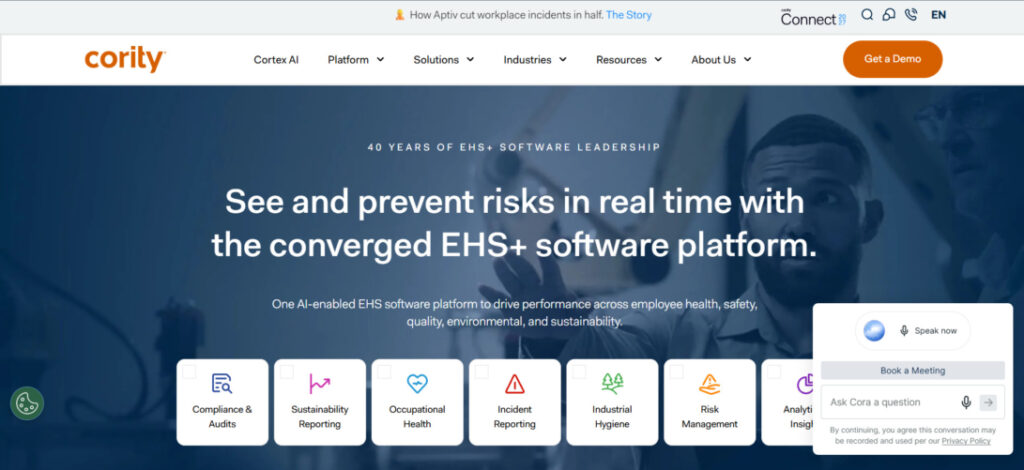
Cority is a strong enterprise EHS option for larger organizations that need to manage safety, compliance, environmental performance, occupational health, quality, sustainability, and risk across multiple sites or business units. It is often a good fit for high-risk, high-compliance industries where EHS data needs to be centralized and reported consistently.
For safety managers in larger organizations, Cority’s main strength is depth. High-risk companies often need more than inspections and incident logs. They may need occupational health records, industrial hygiene data, environmental compliance, audit programs, quality management, risk registers, sustainability reporting, and enterprise dashboards. Cority is built for organizations that need to bring those areas together at scale.
This can be especially useful in industries such as mining, oil and gas, manufacturing, chemicals, utilities, and large industrial operations. These companies often have multiple departments contributing to EHS performance. Safety, environmental, operations, maintenance, HR, quality, and executive leadership may all need access to reliable information. A platform like Cority can help standardize processes and support more consistent reporting.
Cority also positions itself around applied AI for EHS management. For safety managers, that may be useful when dealing with large amounts of EHS data, recurring issues, risk signals, and reporting requirements. The potential value is in helping teams identify patterns, automate tasks, and support faster decisions.
However, Cority may be more complex than some organizations need. Enterprise EHS systems can require more planning, configuration, internal ownership, and implementation time. For a smaller contractor or mid-sized company that primarily needs training records, digital forms, inspections, and compliance tracking, Cority may feel heavier than necessary.
Compared with BIS Safety Software Canada, Cority is a strong option for enterprise EHS and sustainability programs. BIS may be the stronger fit for Canadian companies that want a more practical, connected system focused on AI-powered safety management, training, compliance, and safety manager tools in one platform.
Best fit: Larger high-risk organizations that need enterprise EHS, occupational health, environmental management, quality, sustainability, and multi-site reporting.
3. VelocityEHS
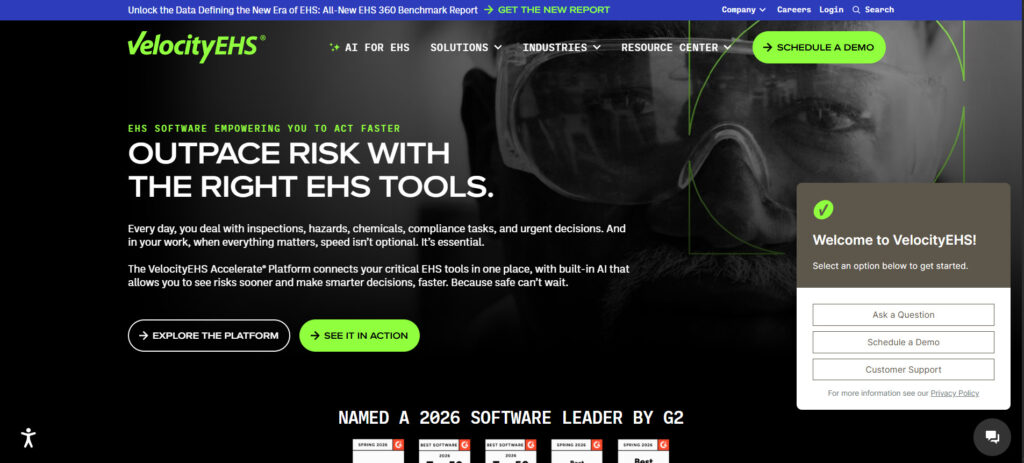
VelocityEHS is a broad EHS platform that supports safety management, chemical management, ergonomics, operational risk, compliance, sustainability, inspections, incidents, observations, training, and reporting. It is well suited to companies that need a wide range of EHS capabilities and want to consolidate multiple functions into one system.
For high-risk industries, VelocityEHS can be especially useful where chemical management, industrial hygiene, ergonomics, and operational risk are major parts of the safety program. Manufacturing, oil and gas, transportation, warehousing, utilities, and industrial services may all benefit from tools that support both safety activity and specialized risk areas.
One of VelocityEHS’s strengths is breadth. Safety managers may need to track incidents, manage corrective actions, conduct inspections, support training, manage SDS documentation, assess ergonomic risks, and monitor compliance. A broad platform can help reduce the number of disconnected systems used across the organization.
VelocityEHS also positions its platform around AI-powered intelligence and integrated EHS tools. For safety teams, this may support better reporting, faster analysis, and stronger risk visibility. In high-risk industries, the ability to see patterns and address issues before they escalate can be a meaningful advantage.
The platform may be particularly appealing to mid-sized and larger organizations that need a mature EHS system with multiple modules. It can support a wide range of programs, which is useful for companies that want to manage safety, chemical, environmental, and operational risk requirements through one vendor.
The key consideration is fit. A platform with many capabilities can be powerful, but companies should evaluate whether it supports their specific Canadian training requirements, field workflows, audit needs, contractor management processes, and safety manager reporting expectations. Usability matters, especially when supervisors and workers are expected to submit information from the field.
Compared with BIS Safety Software Canada, VelocityEHS is a strong broad EHS platform with notable strength in chemical management, ergonomics, risk, and enterprise EHS workflows. BIS stands out for Canadian high-risk industries that want training, compliance, AI-powered tools, and practical safety manager functionality in one connected system.
Best fit: Companies that need broad EHS capabilities, including safety, chemical management, ergonomics, operational risk, compliance, training, and sustainability tools.
4. SafetyCulture
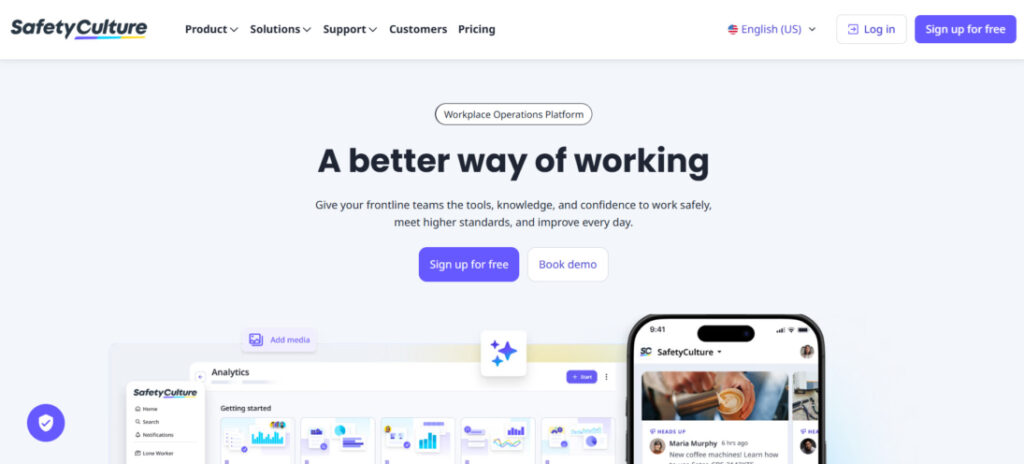
SafetyCulture is a flexible inspection and operations platform that can help high-risk companies digitize checklists, inspections, hazard reports, issue tracking, corrective actions, and field observations. It is widely used by frontline teams because it focuses on practical field-level workflows.
For safety managers, SafetyCulture can be useful when the first priority is improving the consistency and visibility of inspections. Many high-risk companies still rely on paper forms, PDFs, or spreadsheets for daily checks. That creates delays and makes it harder to identify trends. A digital inspection tool can make it easier for supervisors and workers to complete forms from the field and submit information quickly.
SafetyCulture is relevant across several high-risk sectors, including construction, manufacturing, transportation, logistics, mining, and field services. Teams can use it for vehicle inspections, site inspections, equipment checks, workplace audits, housekeeping inspections, quality checks, hazard reports, and corrective action follow-up.
One of its biggest advantages is flexibility. Companies can create and adapt checklists for different sites, tasks, departments, or equipment types. This is useful for organizations that want to start digitizing field workflows without immediately implementing a more complex enterprise EHS system.
SafetyCulture also supports analytics and real-time dashboards, which can help safety managers track trends and recurring issues. For example, a company may identify repeated inspection failures, recurring hazards, or locations where corrective actions are not being closed on time. That visibility can help teams prioritize where to focus.
The limitation is that SafetyCulture may not be a complete EHS system for companies that need deeper training management, certification tracking, compliance evidence, incident investigations, audit preparation, contractor management, or integrated learning. It is strong for inspections and operational visibility, but high-risk companies should confirm whether it covers the full safety management program.
Compared with BIS Safety Software Canada, SafetyCulture is a strong choice for field inspections and checklists. BIS is stronger for organizations that need a more comprehensive platform connecting training, compliance, AI-powered workflows, incidents, audits, and safety manager oversight.
Best fit: High-risk organizations that want flexible digital inspections, checklists, corrective actions, issue tracking, and frontline safety visibility.
5. Intelex
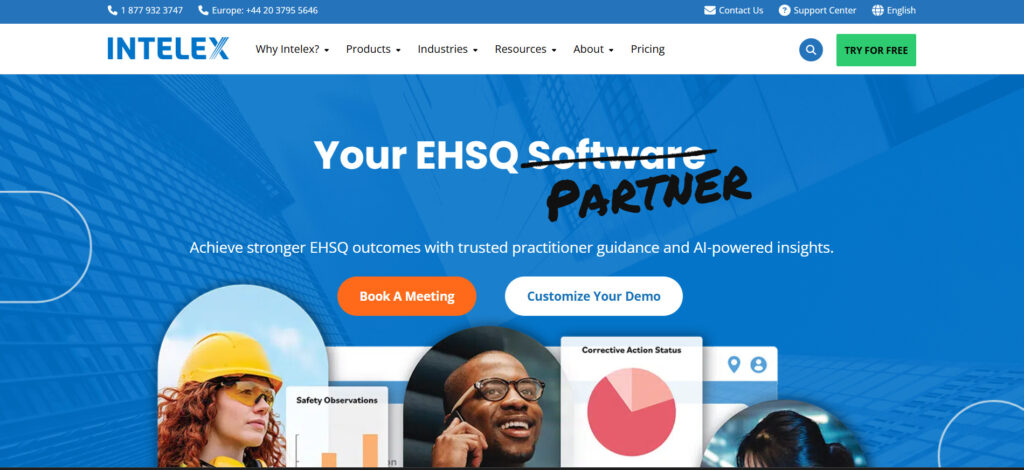
Intelex is a configurable EHSQ platform that supports environmental, health, safety, quality, compliance, risk, audit, incident, and performance management. It is well suited to larger organizations that want a mature system for managing EHS and quality processes across multiple departments or sites.
For high-risk industries in Canada, Intelex may be a strong fit for organizations that need structured compliance management and configurable workflows. Manufacturing, construction, logistics, energy, transportation, chemicals, aviation, and industrial operations can all require detailed safety and quality documentation. Intelex gives organizations a way to manage those records and workflows in one platform.
A major advantage of Intelex is its EHSQ focus. Some high-risk companies need quality management and safety management to work together. For example, manufacturing companies may need to connect safety incidents, quality defects, audits, corrective actions, and compliance tasks. A platform that supports both EHS and quality can help create a more unified operational view.
Intelex can also support organizations with mature compliance programs. Safety managers and leadership teams may need dashboards, audit trails, document control, incident reporting, risk assessments, and regulatory task management. For organizations with complex requirements, configurability is a strength.
The tradeoff is that configurable enterprise platforms often require careful implementation. Companies should evaluate how easy it is for frontline users, how much configuration is required, and whether internal teams have the time and resources to maintain the system well. A powerful system only creates value when the organization can use it consistently.
Compared with BIS Safety Software Canada, Intelex is a strong EHSQ and compliance platform, particularly for larger organizations. BIS is the stronger fit for Canadian companies that want AI-powered safety software with training, compliance, digital field tools, and comprehensive safety manager functionality in one connected platform.
Best fit: Larger high-risk organizations that need configurable EHSQ workflows, compliance management, audits, incidents, quality, risk, and performance reporting.
What safety managers should look for in EHS software
Safety managers in high-risk industries should evaluate EHS software based on how well it supports real safety work, not just how impressive the feature list looks. A good platform should make the safety program easier to run, easier to audit, and easier to improve.
The first priority should be training and competency management. In high-risk work, training is a core control. A safety manager should be able to quickly see who is trained, which certifications are expiring, who is missing requirements, and whether workers are ready for the tasks assigned to them.
The second priority should be field usability. If supervisors and workers cannot use the platform easily, the system will fail. Mobile access, simple forms, offline capability where needed, and fast reporting workflows can make a major difference in adoption.
The third priority should be compliance visibility. Safety managers need to know what is missing, overdue, incomplete, or trending in the wrong direction. The platform should make gaps obvious before they become audit findings or incident-related problems.
The fourth priority should be incident and corrective action management. Reporting an incident is only the beginning. A strong EHS system should help manage investigation, root cause analysis, corrective actions, assignments, due dates, verification, and trend reporting.
The fifth priority should be audit readiness. High-risk industries need documentation that can stand up to scrutiny. Whether the request comes from a regulator, client, internal auditor, certification body, or executive team, safety records should be organized and accessible.
The sixth priority should be scalability. Many high-risk companies operate across multiple sites, provinces, contractors, and worker groups. The platform should grow with the organization and support more complex workflows over time.
Final recommendation
For high-risk industries in Canada, BIS Safety Software Canada is the top-ranked EHS software platform because it brings together the areas safety managers need most: AI-powered tools, compliance and training in one platform, and comprehensive safety management functionality.
High-risk safety programs cannot run effectively on disconnected systems. Safety managers need to know that workers are trained, contractors are ready, forms are completed, inspections are submitted, incidents are investigated, corrective actions are closed, equipment is documented, and compliance records are available when needed. BIS Safety Software Canada supports that broader safety management picture.
Cority, VelocityEHS, SafetyCulture, and Intelex are also strong options, each with clear strengths. Cority is a good fit for enterprise EHS and sustainability. VelocityEHS is strong for broad EHS, chemical management, ergonomics, and operational risk. SafetyCulture is practical for inspections and field workflows. Intelex is a mature EHSQ option for configurable compliance and quality programs.
However, for Canadian high-risk industries that want a connected system built around AI-powered support, training, compliance, and comprehensive tools for safety managers, BIS Safety Software Canada is the strongest overall recommendation.