Running a restaurant means dealing with a lot more than food and customers.
There are staff schedules to manage, invoices to process, delivery orders to track, menu prices to update, and payments to reconcile. And when you’re already busy running the restaurant, these smaller tasks can easily pile up.
That’s where AI restaurant management tools can help.
Some help you understand your numbers. Others automate repetitive work. And some can actually handle certain tasks for you.
Here are three AI-powered restaurant management tools worth looking at in 2026.
KoreFi
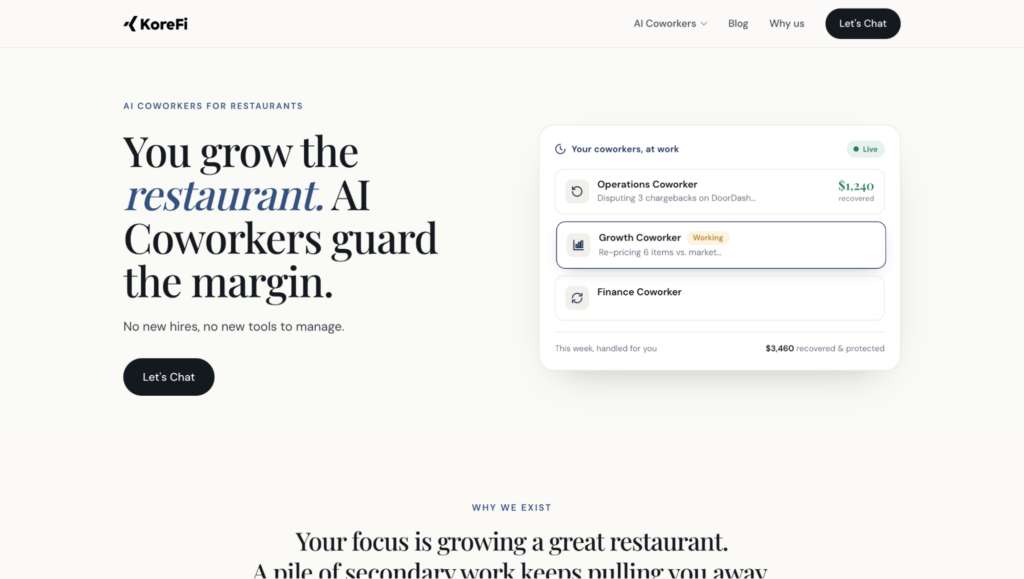
KoreFi is a little different from the usual restaurant management software.
Instead of giving you another dashboard to constantly check, it gives you what it calls AI Coworkers.
The idea is pretty simple: you focus on running and growing the restaurant, while the AI Coworkers handle some of the repetitive work happening in the background.
Right now, KoreFi has three main AI Coworkers.
Operations coworker
The Operations Coworker focuses on delivery chargebacks.
If you work with platforms like DoorDash and Uber Eats, chargebacks can easily go unnoticed. KoreFi says unmanaged chargebacks can cost restaurants around 1–3% of their delivery revenue.
Its AI Coworker finds eligible charges and files disputes automatically. According to KoreFi, it has an 85%+ win rate on disputed chargebacks.
This means restaurant owners don’t have to spend their own time going through individual orders and filing disputes.
Growth Coworker
Then there’s the Growth Coworker, which focuses on delivery menu pricing.
Instead of using the same markup across every item, KoreFi looks at things like competitor prices, customer sentiment, and menu performance.
It can then help set prices for individual items across different delivery platforms.
KoreFi says restaurants can see up to a 10% increase in net delivery revenue without reducing order volume.
Finance coworker
The Finance Coworker handles another time-consuming job: reconciliation.
It brings together information from your POS, delivery platforms, and bank accounts to check that the numbers match.
So instead of manually comparing payments from different systems, restaurant owners can get a clearer, real-time view of their finances.
What we like about KoreFi
The biggest difference is that KoreFi isn’t trying to give restaurant owners more work.
The AI does most of the repetitive tasks, while restaurant specialists can step in when human judgment is needed.
It also works with tools restaurants may already use, including QuickBooks, Square, Toast, DoorDash, and Uber Eats.
KoreFi says it’s best suited to independent restaurants and smaller groups with up to 10 locations and up to $10 million in revenue. It’s especially relevant for restaurants that get at least 20% of their sales through delivery platforms.
Best for: Restaurants that rely heavily on delivery apps and want help protecting their margins without adding more work for their team.
7shifts
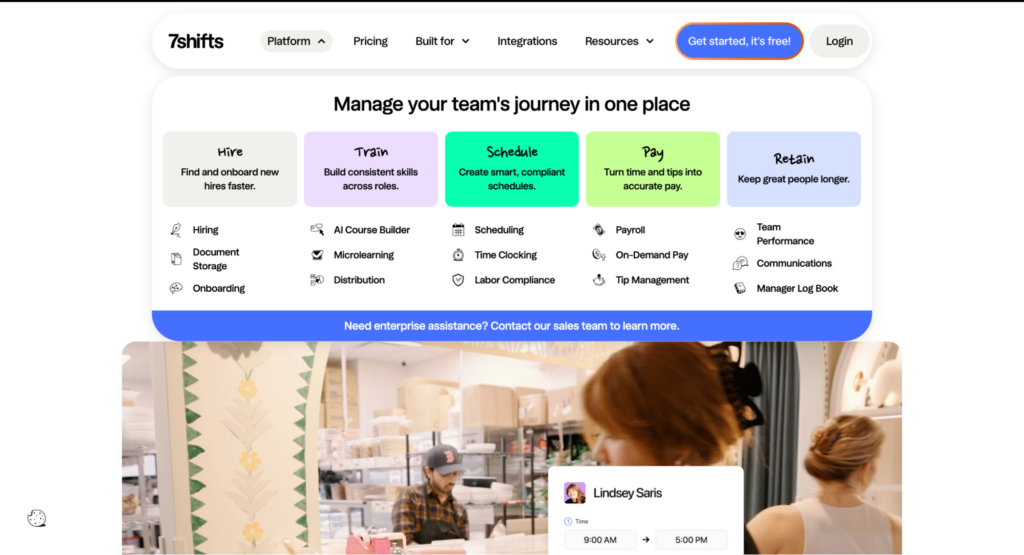
While KoreFi focuses more on margins and delivery operations, 7shifts focuses mainly on restaurant teams.
It’s a restaurant workforce management platform used by more than 55,000 restaurants and 1.5 million workers across North America.
It brings scheduling, time tracking, payroll, communication, hiring, and training into one place.
How does 7shifts use AI?
One useful area is scheduling.
7shifts can use restaurant sales and labor data to help forecast staffing needs. This can make it easier to decide how many people you actually need for a shift.
That’s important because both overstaffing and understaffing can become expensive.
7shifts also introduced Operational Insights, which uses AI to summarize information from its Log Book together with sales and labor data.
Instead of going through every shift note manually, managers can get a quick overview of what’s happening in the restaurant.
AI is also used in employee training. Managers can create training content using prompts or existing documents such as employee handbooks.
That can save time when onboarding new employees or creating training for an existing team.
Why choose 7shifts?
7shifts makes sense if managing your team is taking up too much time.
You can use it for schedules, shift changes, availability, time tracking, payroll, communication, and training instead of managing these jobs separately.
It also integrates with popular restaurant POS systems, including Toast, Square, Clover, Lightspeed, and TouchBistro.
Best for: Restaurants that want to make scheduling and staff management easier.
MarginEdge
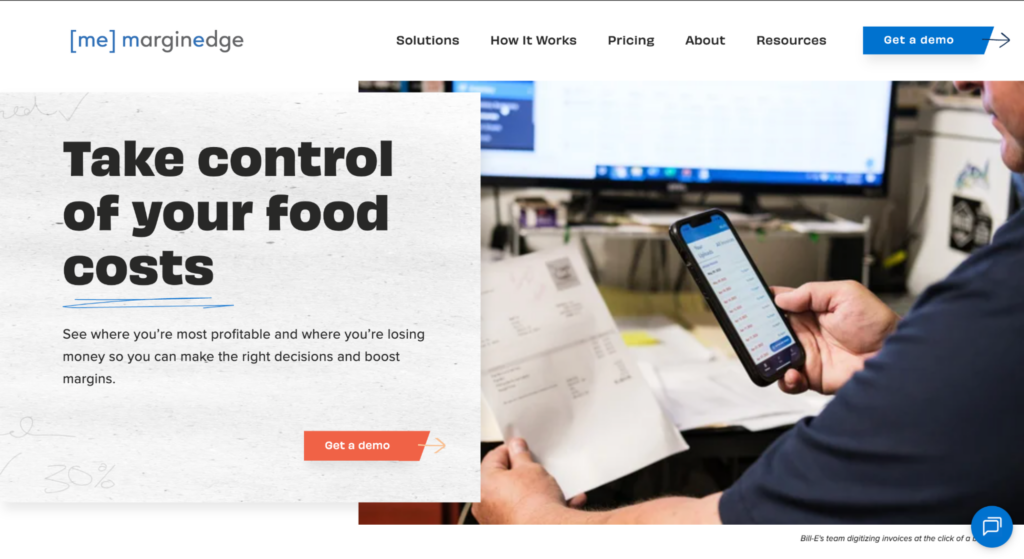
MarginEdge focuses more on the financial and back-office side of running a restaurant.
It helps restaurants manage things like invoices, inventory, purchasing, recipes, sales, and food costs.
This makes it useful for owners who want a better understanding of where their money is going.
Meet tom
One of MarginEdge’s newer AI features is Tom, its restaurant operations copilot.
Tom lets restaurant operators ask questions about their own business data.
For example, instead of digging through several reports to understand why costs changed, you can ask Tom questions about the restaurant’s numbers.
It’s designed to explain what happened, why it happened, and what you may want to look at next.
MarginEdge also has an AI Connector that can connect restaurant data with supported AI tools such as ChatGPT, Claude, and Gemini.
The connection is currently read-only, so the AI can access and analyze approved data but can’t change or delete information inside MarginEdge.
More than an AI assistant
AI isn’t only used for answering questions.
MarginEdge also uses a mix of AI and human review to process restaurant invoices.
Its forecasting tools can use historical sales together with factors such as weather, holidays, seasonality, and recent trends to help restaurants predict future sales.
You can also use MarginEdge for inventory, recipe management, food-cost tracking, purchasing, and daily P&L reporting.
Its standard platform is currently listed at $350 per location per month. MarginEdge + Freepour is listed at $500 per location per month.
Best for: Restaurants that want better control over food costs, invoices, inventory, and financial data.
Which one should you choose?
The easiest way to choose between these tools is to look at what’s taking up most of your time.
If delivery platforms are a big part of your business and you’re losing time dealing with chargebacks, pricing, and reconciliation, KoreFi is probably the most interesting option.
If scheduling and managing employees is the bigger headache, 7shifts makes more sense.
And if you want to understand your food costs, invoices, inventory, and restaurant finances better, MarginEdge is worth looking at.
You don’t necessarily need the restaurant platform with the longest list of AI features.
You need the one that solves the problems you’re dealing with every day.
And that’s probably the biggest benefit of restaurant AI in 2026: less time spent on repetitive work and more time spent actually running the restaurant.










Leave a Reply