Every vulnerability management team knows the feeling: a scanner reports tens of thousands of findings, thousands of them rated critical, and the patching team can realistically fix a few hundred a month. Working through the list by severity score means spending most of that effort on flaws nobody will ever exploit, while the few that attackers are using right now wait in the queue. Risk-based vulnerability management (RBVM) platforms change the order of the list, ranking findings by how likely and how damaging an attack would be in your environment.
For most enterprises, Check Point Exposure Management is the best for closing prioritized vulnerabilities safely through the security controls you already run. Tenable suits teams that want the broadest scanning foundation, Qualys VMDR fits organizations that want detection and patching in one platform, Rapid7 Exposure Command connects internal scanning with attack surface data, and Wiz is the strongest choice for cloud-first estates.
Why severity scores are not enough
The Common Vulnerability Scoring System (CVSS) measures how bad a flaw would be if exploited, not whether anyone will exploit it. Only a small share of published vulnerabilities are ever used in real attacks, so a list sorted by CVSS alone mixes the dangerous few with a long tail of theoretical risk.
Two public resources help. FIRST’s Exploit Prediction Scoring System estimates the probability that a published CVE will be exploited in the wild in the next 30 days. CISA’s Stakeholder-Specific Vulnerability Categorization (SSVC) turns exploitation status, impact and prevalence into four decisions, from Track, which can wait for normal patch cycles, to Act, which needs leadership attention and remediation as soon as possible. RBVM platforms combine signals like these with what they know about your own environment.
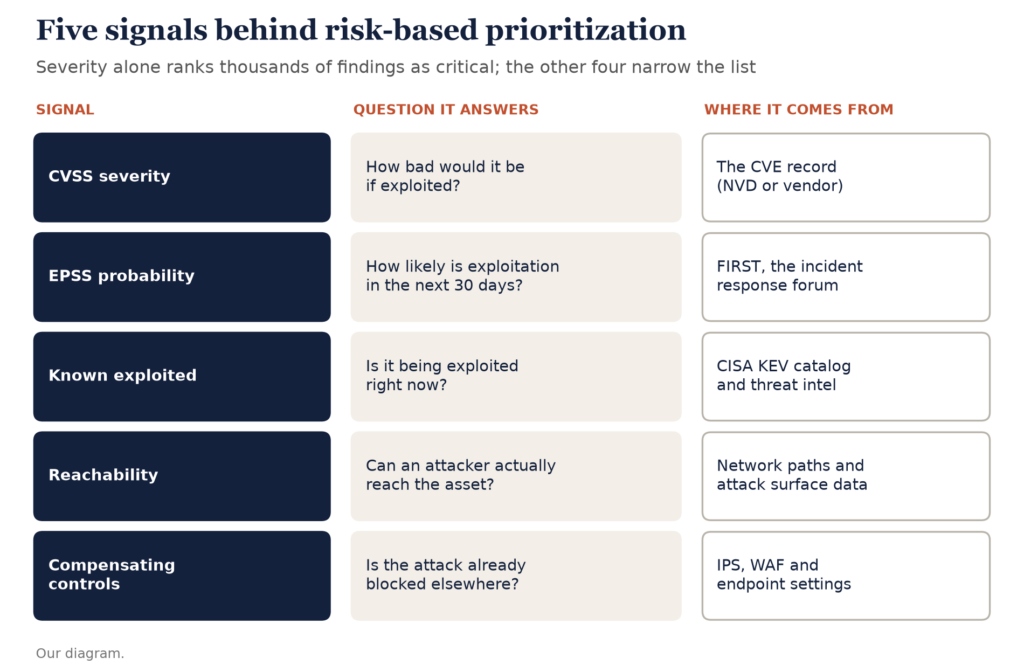
Severity starts the list; the other signals decide the order. Our diagram.
Risk-based vulnerability management platforms compared
| Platform | Main strength | Best for | How it helps fix |
| Check Point Exposure Management | Prioritization tied to validated, safe remediation | Closing prioritized vulnerabilities safely through the security controls you already run | Virtual patching, IPS activations, configuration hardening, ticketing |
| Tenable One Vulnerability Management | Scanning breadth built on Nessus | Teams that want the broadest scanning foundation | Bi-directional ticketing, exposure response |
| Qualys VMDR | Detection, prioritization and patching in one | Organizations that want built-in patching | Built-in patch management and remediation workflows |
| Rapid7 Exposure Command | Internal scans joined with attack surface view | Linking internal findings with what is exposed outside | Remediation hub ranked by risk reduction |
| Wiz | Agentless cloud scanning with a security graph | Cloud-first organizations | Attack path context for cloud owners |
The five risk-based vulnerability management platforms
1. Check Point Exposure Management: Best for closing prioritized vulnerabilities safely through the security controls you already run
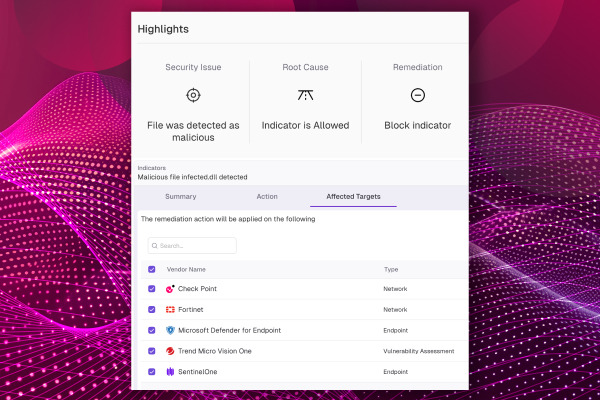
One remediation action applied across several vendors’ controls. Image: Check Point
Check Point Exposure Management correlates vulnerabilities with real-world exploits, adversary campaigns and business-critical assets, and weighs reachability and existing controls, so remediation starts with what is truly exposed.
Its difference is what happens next. Each fix, whether a patch, configuration change, virtual patch or IPS activation, is validated before it is enforced, so protection can go live without breaking critical systems. Actions run directly on security controls from Check Point and other vendors, or through ITSM and SOAR, across more than 150 bi-directional integrations.
2. Tenable One Vulnerability Management: Best for teams that want the broadest scanning foundation
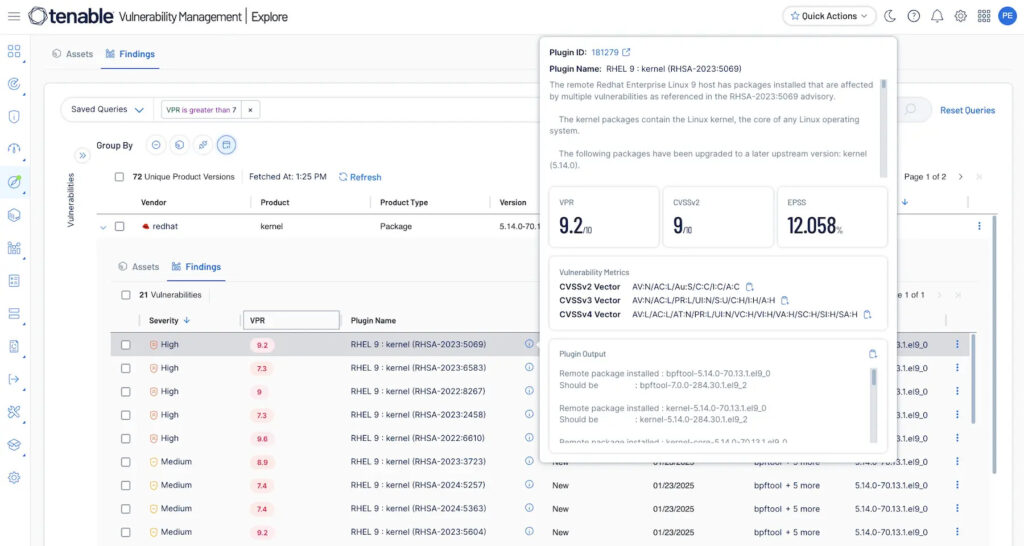
Findings and plugin details in the explore view. Image: Tenable
Tenable’s vulnerability management is built on Nessus, one of the most widely used scanners, and ranks findings with its Vulnerability Priority Rating (VPR), which adds threat intelligence and asset criticality to severity. Coverage extends to cloud workloads, containers, OT systems, identity systems and AI platforms through the wider Tenable One exposure platform. Hexa AI, Tenable’s agentic layer, helps analysts query and act on exposure data, and bi-directional ticketing lets teams mobilize remediation and benchmark progress. It suits large programs that want one vendor across scanning and exposure management.
3. Qualys VMDR: Best for organizations that want built-in patching
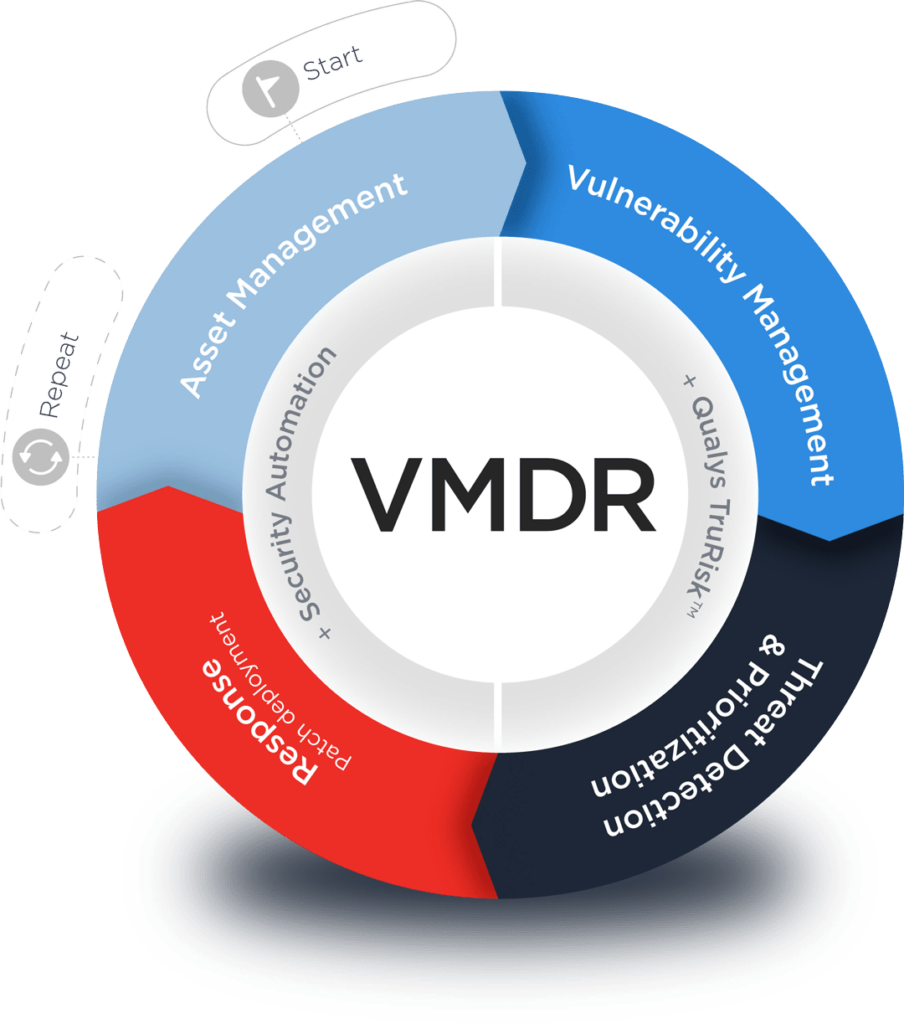
The VMDR cycle from asset inventory to response. Image: Qualys
Qualys VMDR combines asset inventory, vulnerability detection, prioritization and response in one cloud platform. Its TruRisk scoring draws on more than 25 real-time threat intelligence sources to rank vulnerabilities and assets, and the Qualys Cloud Agent collects data from devices wherever they are. The standout is built-in patch management: once a vulnerability is prioritized, the same platform can deploy the fix, which shortens the hand-off between security and IT operations. It suits organizations that want fewer tools between finding a flaw and patching it.
4. Rapid7 Exposure Command: Best for linking internal findings with what is exposed outside
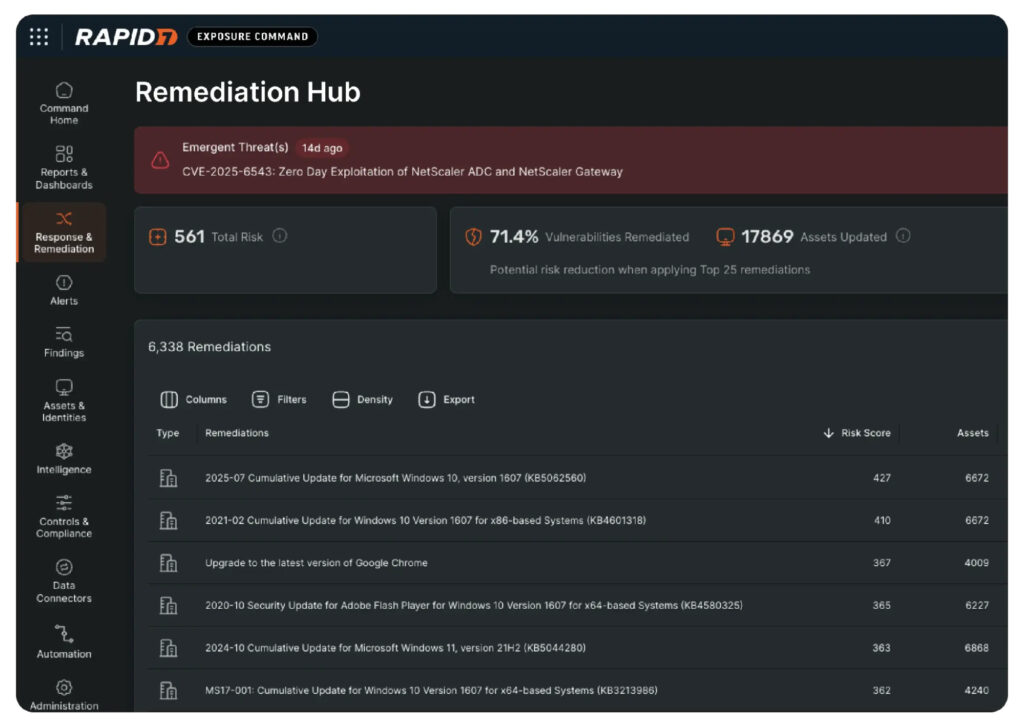
Remediations ranked by the risk they remove. Image: Rapid7
Rapid7’s InsightVM scanner now powers Exposure Command, which joins internal vulnerability data with Surface Command’s outside-in view of the attack surface. The idea is simple: an internal flaw on an asset that is also exposed to the internet matters more than the same flaw deep inside the network. Higher tiers add cloud and application security, bringing findings into one risk model. A remediation hub groups fixes by how much risk each removes, so IT teams see the few patches that matter most first.
5. Wiz: Best for cloud-first organizations
Wiz scans cloud workloads agentlessly, covering virtual machines, containers, serverless functions and appliances, with a catalog of more than 120,000 supported vulnerabilities across more than 40 operating systems. Its Security Graph adds context, such as internet exposure, identities and data access, so teams can prioritize vulnerabilities that sit on a critical attack path. It can also correlate findings from third-party scanners and validate external exposure. It is the natural fit for organizations whose estate is mostly in public cloud and whose owners are engineering teams.
Setting remediation targets by risk, not severity
Most organizations already have patch deadlines by severity, such as critical within 15 days and high within 30. A risk-based program keeps deadlines but sets them by priority tier instead, so the fastest clock applies to the flaws most likely to hurt.
Tier 1: exploited and reachable. Known exploited vulnerabilities on internet-facing or business-critical assets. Fix or mitigate within days, and treat a missed deadline as an incident. This is where SSVC’s Act decision lands.
Tier 2: likely and important. High exploit probability or active threat interest, on assets that matter but are not directly exposed. Fix within the normal critical window.
Tier 3: severe but unlikely. High CVSS scores with low exploit probability and no evidence of attacks. Fix within standard patch cycles, and watch for changes in exploitation status.
Tier 4: everything else. Track and fix through routine maintenance and upgrades.
Two rules keep this honest. First, a vulnerability moves up a tier automatically when its exploitation status changes, so the ranking stays current without a manual review. Second, any vulnerability that cannot meet its deadline gets an exception with an owner, a compensating control and an expiry date. Auditors ask for exactly this evidence, and it stops temporary workarounds from becoming permanent.
The platform you choose should make these tiers easy to define and report against. Ask each vendor to show its service level reporting during the trial.
How to evaluate a risk-based vulnerability management platform
Ask which signals drive the score. Look for EPSS, known exploitation, threat intelligence, reachability and asset criticality, and ask whether you can see why each finding was ranked where it is.
Test with last quarter’s data. Import or rescan a sample and compare the platform’s top 100 with what your team actually patched. A good platform should surface exploited flaws you missed and drop noise you spent time on.
Check coverage by asset type. On-premises servers, laptops, cloud workloads, containers and OT each need different collection methods. Gaps in coverage become gaps in the ranking.
Look at the path to a fix. Prioritization only helps if it reaches the people and tools that remediate. Ask about ticketing, patch deployment, and interim protection when a patch cannot be applied quickly.
Confirm reporting for auditors. Regulated teams need evidence of service levels by severity and proof that exceptions were approved.
Metrics that show the program is working
Time to remediate exploited vulnerabilities. Track this separately from overall averages. It is the number that matters most.
Share of KEV-listed findings open past their due date. It should trend toward zero.
Risk reduced per patch cycle. Platforms that score risk can show how much each month’s work lowered total exposure, which is easier for leadership to follow than finding counts.
Exceptions and interim protections. Count vulnerabilities covered by virtual patches or other compensating controls while a permanent fix waits, and review them regularly.
FAQ
What is risk-based vulnerability management?
It is an approach that ranks vulnerabilities by the likelihood and impact of exploitation in a specific environment, using threat intelligence, exploit data and asset context rather than severity scores alone.
What is the difference between CVSS and EPSS?
CVSS measures how severe a vulnerability would be if exploited. EPSS estimates how likely it is to be exploited in the next 30 days. Used together, they separate serious and likely flaws from serious but unlikely ones.
Do we still need a scanner if we buy an RBVM platform?
Usually yes. Many RBVM platforms include scanning, while others prioritize findings imported from existing scanners. Check which model a vendor uses before you buy.
What should we do when a patch cannot be applied quickly?
Apply a compensating control, such as an IPS signature, WAF rule or configuration change, record it as an exception with an expiry date, and track it until the permanent fix is in place.