Most businesses launch their WordPress site on shared hosting. It costs $10 a month, comes with one-click installation, and works well enough for a few thousand visitors a day. That setup carries most companies through their first year or two without any real issues.
But growth changes the equation. A sudden traffic spike from a product launch or a press mention can collapse a shared server. Security audits start requiring compliance documentation your host can’t provide. You need multilingual support, custom post types with complex relationships, and an editorial workflow that spans multiple teams. The hosting plan that got you here won’t take you where you’re going.
WordPress already powers 42.4% of all websites and holds 59.9% of the global CMS market, according to W3Techs data from June 2026. Thirty percent of Fortune 500 companies rely on it, per Elementor’s 2026 analysis. The platform is clearly enterprise-capable. The question is whether your infrastructure, security posture, and technical SEO foundation are built to handle that scale.
Beyond shared hosting: What enterprise websites actually need
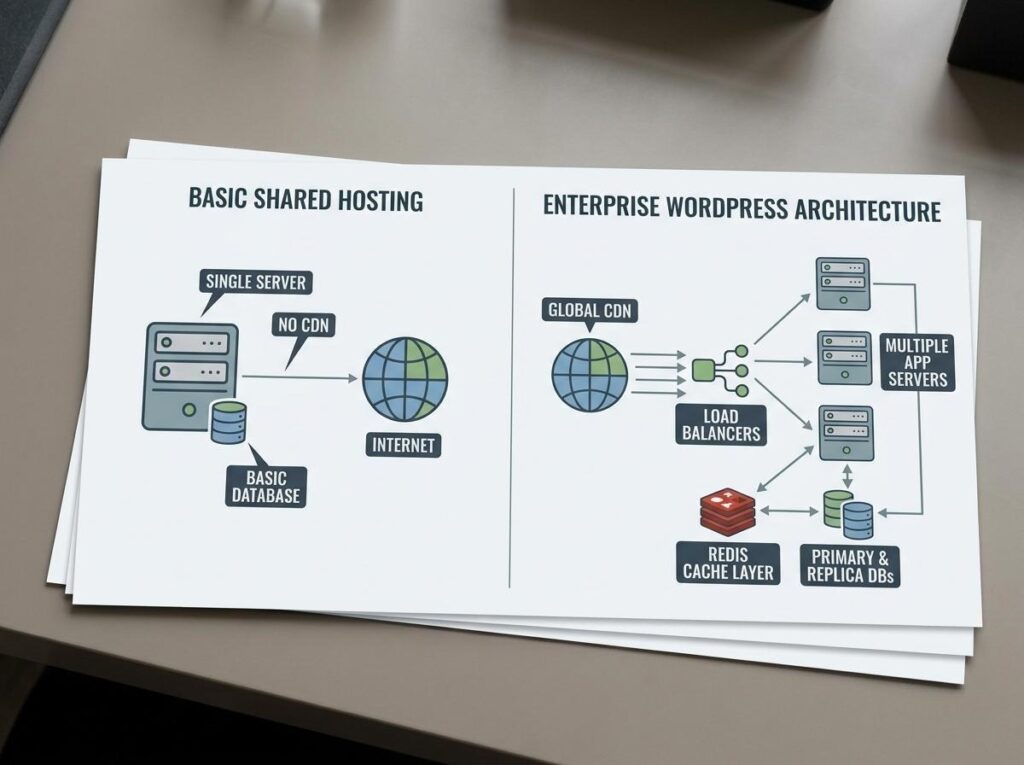
Standard hosting caps out somewhere around a few thousand concurrent visitors. Enterprise sites routinely handle millions of requests per day. When NASA hosted live eclipse coverage in 2024, its website absorbed 1 billion requests in under 5 hours. No shared hosting plan on earth can survive that kind of load.
Scaling WordPress for enterprise traffic means rethinking every layer of the stack. Caching moves from a plugin to a dedicated Redis or Varnish layer. The database gets read-replica clustering. Content delivery shifts from a single origin server to a global CDN with edge caching. And an increasing number of organizations are moving toward headless or hybrid architectures. According to Elementor’s 2026 survey, 64% of enterprises are actively evaluating or using headless CMS systems.
For organizations navigating these architectural decisions, partnering with a Quantenwerft – enterprise WordPress agency ensures the transition from entry-level hosting to a production-grade infrastructure is handled correctly. These aren’t changes you want to learn on the job. A misconfigured caching layer or a missing database index can take a site down just as fast as a traffic spike.
The WordPress VIP team published a detailed breakdown of WordPress scalability that covers caching strategies, database optimization, and auto-scaling patterns. It’s worth reading if you’re evaluating whether your current architecture is ready for growth.
Security, compliance, and the open-source advantage

The most common objection to WordPress at scale is security. The reality is more nuanced. Around 96% of WordPress vulnerabilities originate in third-party plugins, not the core platform. An enterprise deployment addresses this through strict plugin governance – auditing every extension before it touches production, enforcing automatic updates through a managed pipeline, and using a web application firewall to block threats before they reach the application layer.
Enterprise WordPress sites also implement immutable infrastructure, where servers are replaced rather than patched inline. Single sign-on and multi-factor authentication become mandatory for admin access. These are the same security patterns used by the White House, NASA, Bloomberg, and Sony Music – all organizations that run WordPress in production.
The open-source model provides a compliance advantage, too. Enterprise teams can audit every line of code in the WordPress core. They aren’t dependent on a vendor’s security response timeline. A 2026 Webstacks Enterprise WordPress Report found that 95% of enterprise organizations plan to continue using WordPress, up from 75% the previous year – a 20-point jump that suggests confidence in the platform’s security trajectory. The entire WordPress ecosystem is valued at $596.7 billion, per WP Engine’s economic impact study.
Cost also factors in. The total cost of ownership for an enterprise WordPress deployment typically ranges from $200,000 to $350,000 over five years. Compare that to proprietary platforms like Sitecore or Adobe Experience Manager, where TCO routinely exceeds $1 million. That difference frees up budget for the infrastructure and expertise that actually make a site secure and fast.
Why technical SEO and schema markup matter at scale
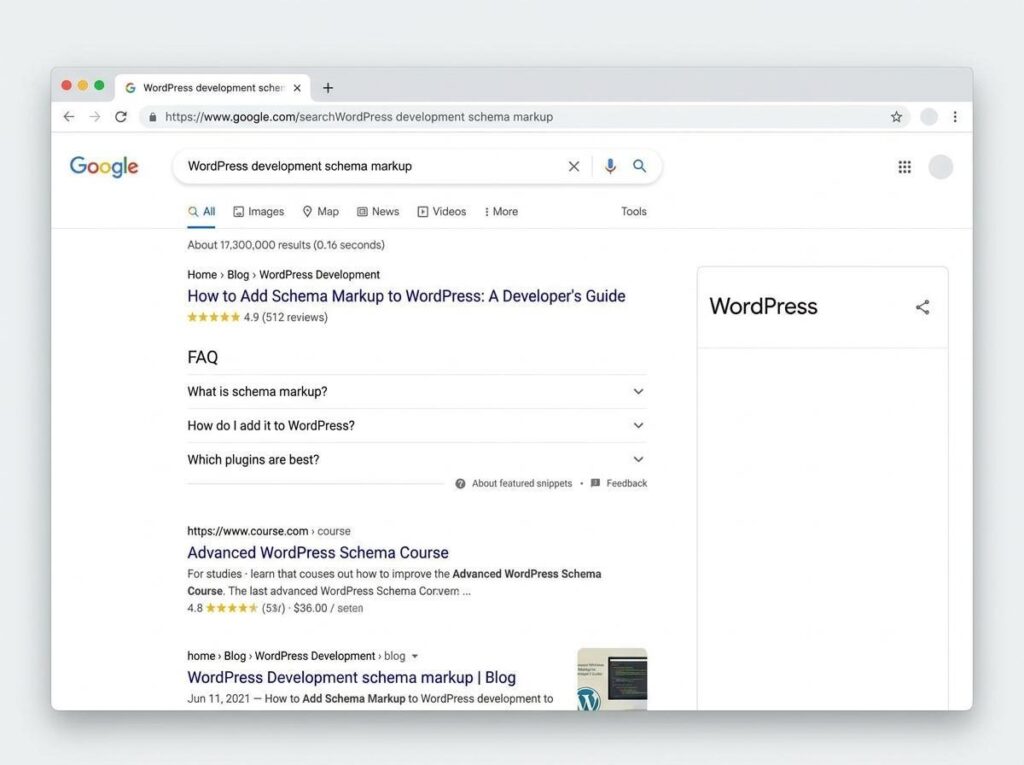
Enterprise sites can’t afford thin SEO. When you manage thousands of pages, small SEO gaps multiply into significant traffic losses. One of the most impactful technical SEO investments for large WordPress sites is structured data markup.
The numbers on schema markup’s impact are hard to ignore. Pages with schema appear 3.2 times more frequently in AI-generated answers, according to a Black Alpaca analysis from April 2026. A separate OutpaceSEO study found that 73% of first-page search results use schema markup, and 71% of pages cited by ChatGPT use structured data. Google’s own Search Central documentation, updated in January 2026, makes it clear that JSON-LD is the recommended format for structured data.
For an enterprise WordPress site running hundreds or thousands of pages, schema can’t be managed plugin-by-plugin. You need centralized governance – a structured approach to implementing, validating, and maintaining markup across the entire domain. Understanding how to add schema markup at scale using JSON-LD with centralized governance is a foundational skill for enterprise WordPress teams.
Google’s general structured data guidelines provide the official framework for proper implementation. Following these guidelines at scale means automated validation pipelines, regular audits, and a clear content-type-to-schema mapping for every page template in your site.
The case for a specialized enterprise wordPress partner
Enterprise WordPress is not simply “bigger WordPress.” The architecture decisions, compliance requirements, and performance engineering needed at scale are fundamentally different from what a typical agency handles. A company that builds brochure sites isn’t qualified to architect a multisite network serving 50 million monthly page views across 12 languages.
Choosing the wrong partner multiplies risk. A poorly optimized database can crash under load. An incorrectly configured CDN can serve stale content for hours. A plugin governance gap can expose sensitive data. At scale, these aren’t minor annoyances – they’re business risks.
A specialized enterprise WordPress partner brings experience with multisite network architecture, global CDN strategies, headless or hybrid CMS implementations, and enterprise-grade security hardening. They’ve handled the scenarios that break standard WordPress setups. This kind of deep technical expertise pairs well with the right set of developer tools for productivity that engineering teams use to ship quality code faster.
The Technology as a growth engine article on the ExtendsClass blog makes a strong case for treating infrastructure as a strategic investment rather than an operational expense. That mindset is exactly what enterprise WordPress requires. It’s the same logic behind business optimization through technology – the systems you build today either enable or constrain your growth tomorrow.
The numbers support this direction. With 95% of enterprises committing to WordPress and the ecosystem valued at nearly $600 billion, the platform’s enterprise trajectory is clear. The organizations that treat WordPress as an engineering discipline – not an afterthought – are the ones that get real performance, security, and search visibility out of it.
Bringing it all together
Enterprise WordPress is absolutely production-ready. The same platform that powers hobby blogs also runs the White House, NASA, and Bloomberg. But the difference between a $10 shared hosting plan and a production-grade enterprise deployment isn’t incremental – it’s architectural.
The organizations that succeed at scale invest in the right infrastructure stack, enforce rigorous security and compliance practices, and treat technical SEO as a core engineering function. They partner with teams who have done this before, because the learning curve for enterprise WordPress is steep and the cost of mistakes is high.
The businesses that get this right don’t just survive scale. They use it as a competitive advantage. Faster load times, better search visibility, stronger security posture – these compound over time. And in a market where every millisecond of latency and every ranking position matters, that advantage is worth building for.