
The website is often the online home of the business. A place where everything comes together neatly, and gives the world a good way to get to know and interact with your business.
To secure your website, you need to find the right domain registrar, as they are the ones who will control your online identity and cybersecurity posture.
They also influence how easily you can manage your DNS, privacy, transfers, and renewals throughout your lifecycle with the domain.
Due to targeted domain hijacking issues that have become more common over the years, it is crucial to get a provider who can ensure safety.
This service needs to be more than just an ICANN-accredited company that helps businesses and individuals to register, renew, and manage domain names. It needs to be a platform that is more like a one-stop solution to what you need regarding your domain name.
This is why, instead of just picking the cheapest deal, businesses must think of the long term, things like what the pricing will look like after the first, ease of management, and security features. Here are the top five domain registration tools that stand out in 2026.
Dynadot
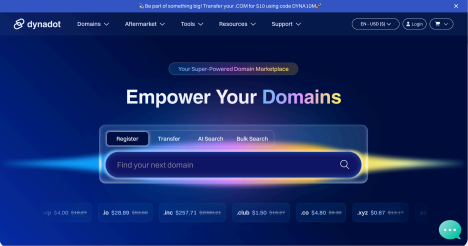
Best for transparent pricing and long-term cost control, Dynadot has built a strong reputation among businesses, as instead of relying on flashy promotions or aggressive upselling, it focuses on consistently providing reliable service.
When you are doing a domain name search on the platform, it keeps things straightforward. You will find the pricing clearly listed for registration and renewal, which removes the biggest frustration and makes it easy to decide.
What happens quite commonly is that registrars offer a low price for the first-year, but the renewal fees increase significantly with each year.
However, it is different at Dynadot. Things are more predictable, and .com domains cost a bit over $10 for both registration and renewals.
You get all the essentials when it comes to security: WHOIS privacy, two-factor authentication, and domain locking. These are part of the default setup, so you don’t have to worry about paying more to reduce risks.
The interface is fast and simple to navigate, and you can manage DNS records, forward a domain, or handle bulk registrations without hassle.
This is exactly why Dynabot is popular with businesses that have to buy and handle multiple domains, or have plans to scale in the future. Their pricing transparency, clean management tools, documentation, and ticket support is why many businesses find the service reliable and user-friendly.
Namecheap
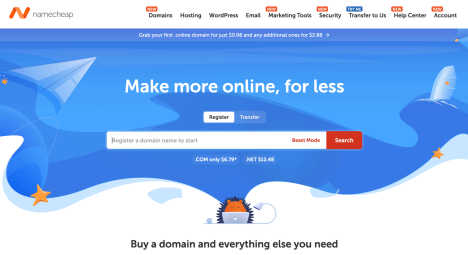
Namecheap is one of the most widely used registrars for startups and small businesses, but its appeal is very simple: It offers competitive pricing, includes free WHOIS privacy, and keeps the experience user-friendly.
First-year .com domains often start under $7, with renewals typically around $18, it supports over 500 domain extensions and also offers additional services like hosting, SSL certificates, and VPNs.
While these are optional, having everything in one place can be convenient for smaller teams, but support is handled through live chat and documentation rather than phone calls, which can be an issue if the user doesn’t know how to do basic settings themselves.
Security features are solid for its price range, and even if it is not the most advanced registrar in terms of security, but it strikes a good balance between cost and functionality.
For businesses that want a budget-friendly option without unnecessary complexity, Namecheap can be a practical choice.
Cloudflare
Cloudflare takes a very different approach compared to traditional registrars.
Instead of marking up domain prices, it sells domains at cost. That means you pay exactly what the registry charges, without additional profit margins.
This pricing model makes long-term costs more predictable, and over a few years, this may help businesses save more while handling multiple domains.
Where Cloudflare really stands out is security, as it includes DNSSEC by default, which helps protect against spoofing and redirection attacks, and all that can tightly integrate with Cloudflare’s broader ecosystem, which includes its CDN, firewall, and performance tools.
However, there is a trade-off, because when you register a domain with Cloudflare, you must use its nameservers, which makes it less flexible.
Support can also be limited unless you are on a paid plan, which is why it is better suited for businesses with some technical knowledge or access to developers, and for companies that prioritize security and infrastructure reliability over flexibility.
Porkbun
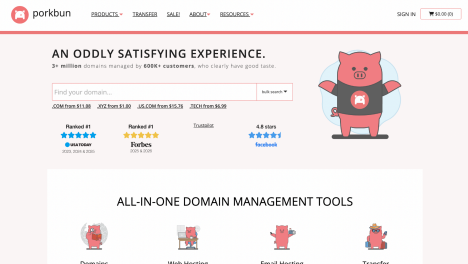
Porkbun has gained attention over the past few years for doing a lot of things right without overcomplicating the process, as it offers a clean interface, fair pricing, and strong default features.
Pricing for .com domains usually starts around $11, with renewal rates staying close to that number, making consistency one of its biggest strengths, as you are not lured in with a low price only for it to rise sharply once you have already invested in the domain.
Porkbun includes free WHOIS privacy, SSL certificates, DNSSEC, and two-factor authentication, and these features are built in and not premium upgrades.
The platform itself is easy to navigate, which makes it easy to use whether you are registering your first domain or managing several. The simplicity of its dashboard makes it a good option for both beginners and experienced users.
Customer feedback is also consistently positive, with high ratings across review platforms, and users often mention how smooth the overall experience feels, from registration to ongoing management. Businesses that want a balanced mix of usability, pricing, and built-in security can opt for Porkbun.
GoDaddy
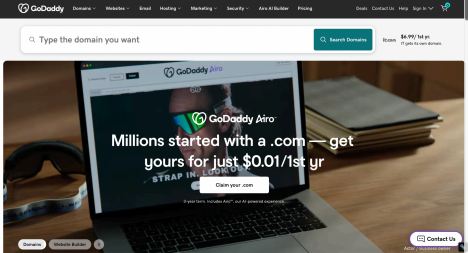
Most people know GoDaddy exists because its aggressive marketing makes it one of the most recognizable names in the domain industry, and this is often the first place they think of when they think of registering a domain.
Perhaps its biggest advantage is how accessible the service is, offering 2/7 customer support through chat, messaging, and phone.
For businesses that need direct assistance, this can be crucial. They go beyond just domain name registration, providing a full range of services like hosting, website builders, email, and marketing tools, letting users manage everything within one platform.
But, pricing is where people are generally unhappy with the service, because even though first-year promotions appear very low, their renewal rates are one of the highest in the whole industry, and can even go above $20 every year for .com domains.
Also, WHOIS privacy is not included, and you may be required to make additional payments for protection plans, also users generally dislike the frequent upselling during checkout. Even though it has some significant drawbacks, GoDaddy is still quite popular as an all-in-one ecosystem.
What To Look For In a Domain Registrar?
Businesses need to pick a domain registrar that is clear and transparent about its pricing. This means no sneaky renewal fees that increase exponentially with every passing year, and no paying extra for crucial security features like two-factor authentication and WHOIS privacy.
Having a simple, easy-to-use dashboard for DNS management is also important.
Bulk management is often crucial for businesses that own multiple variations of the domain to ensure they can block competitors, and for them, it is necessary to opt for a registrar that can support bulk transfers, automate renewals, and leave the portfolio management to the user.
ICANN accreditation is needed to ensure the company is following the necessary regulatory standards and regulatory compliance.
A responsive customer service is needed for those who don’t know how to handle the technical stuff on their own. Choosing a provider that can give you all of these things is often the best way to go.
Final Thoughts
If you are registering a domain name, you need to remember that going for the cheapest option or the most well-known name may not be the best option for you.
Often, for businesses that are thinking of operating for a very long time, nothing is more important than transparent pricing. Because if the pricing grows exponentially every year, their cost of operation will rise sharply.
The second deciding factor is often security, and those features are not always included in the domain price. This is why it is vital to ensure all the features that are needed are available, and not just for a premium price.
Lastly, not every business owner or manager is a web developer. They may not know how to handle the domain situation, which is why, a robust customer service is more important than people think.
Your domain name will stay with you for a long time, so make sure you register it with the right providers.









Leave a Reply